At its narrowest point, just thirteen kilometres of water separate Europe from Africa. I grew up on the south-east coast of the UK where one could often make out the coastline of France, just 33 km away at its closest point.
I have fond memories of standing on the white chalk cliffs that guarded my hometown from the sea below and being able to make out the same milky-coloured rock faces across the Channel, rising up from the sea like giants’ teeth and marvelling at the fact that beyond them stood a world similar to mine but also very different.
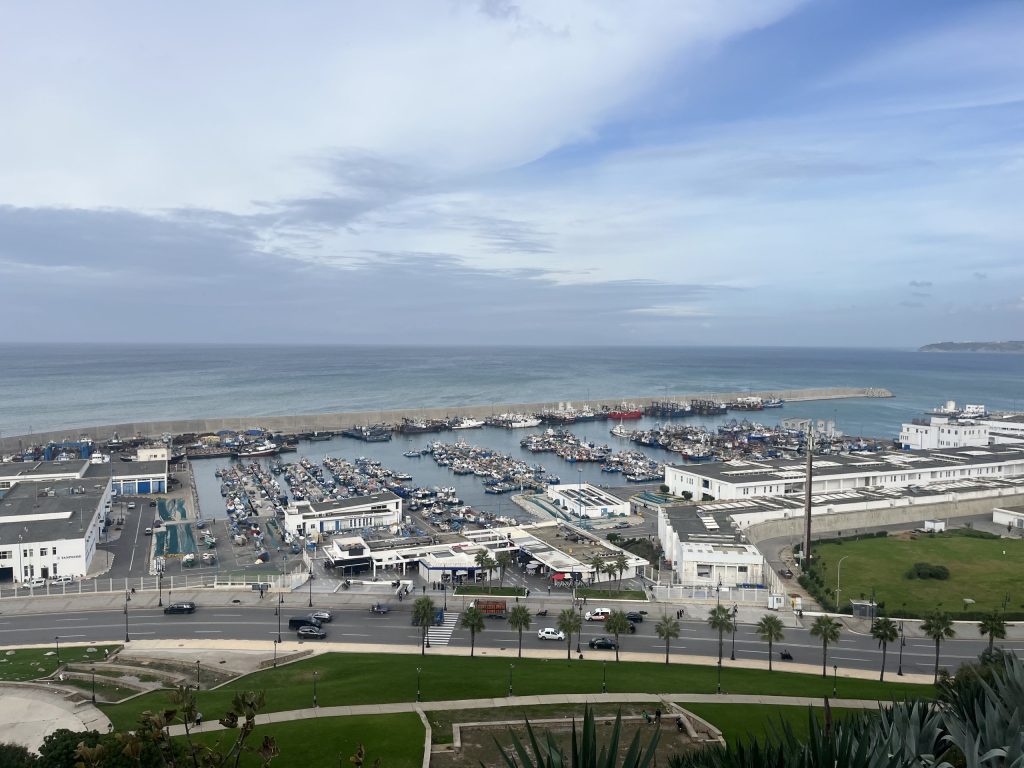
On a clear day you could often make out the buildings of Calais and the white chalk cliffs of Cap Blanc-Nez and it seemed as though, if I just shouted a bonjour loud enough, I’d get a reply. But here, at the Strait of Gibraltar, it seemed almost possible for Europeans and Africans to shake hands.
The Strait connects the Atlantic Ocean with the Mediterranean Sea and for centuries has been an important passage between the two continents. To the ancient Greeks, the waters around its western entrance marked the edge of the known world, the legendary Pillars of Hercules standing either side of the gateway to the great unknown beyond.
The oceans and landmasses may now have been mapped and largely explored but standing in the fading light of a November evening at the southern edge of the European continent, it was very easy to feel something of the same sense of trepidation and awe that those Greeks might have felt before me. After more than a year of planning and several weeks of riding south through Europe, I was about to cross into Africa, a continent as unknown to me as the great oceans beyond the strait were to those ancient sailors. The real adventure, it seemed, was about to start.
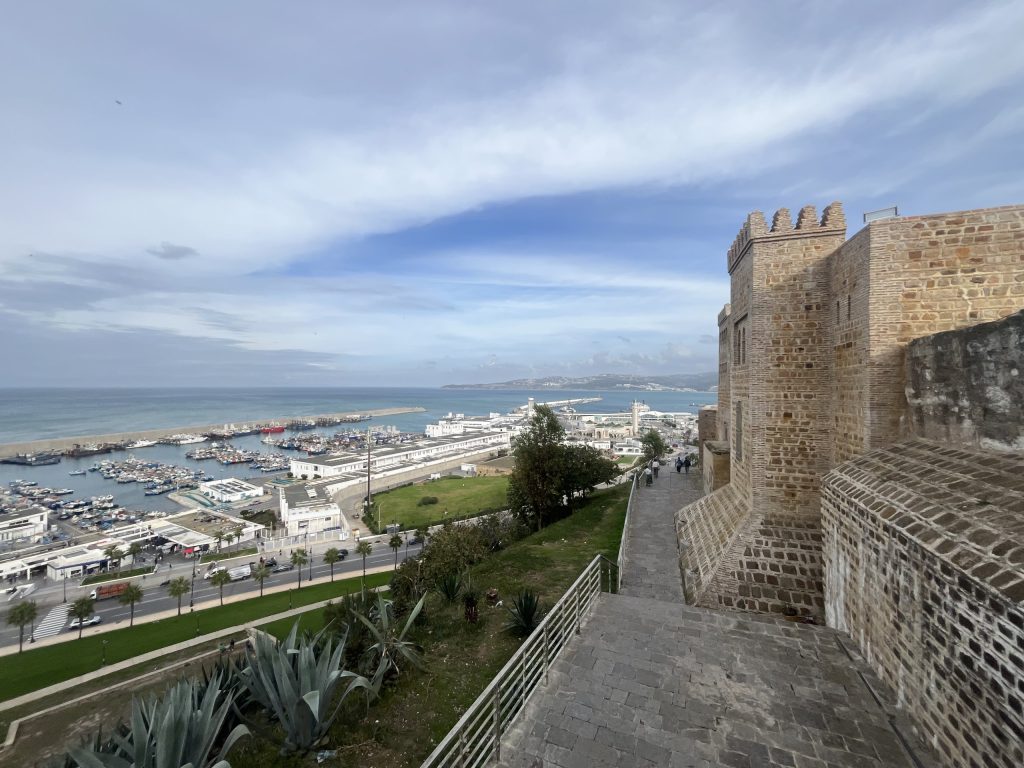
The ferry from Tarifa to Tangier doesn’t cross the strait at its narrowest point, instead, it takes a route of a little over thirty kilometres, crossing in a little over an hour, although after the battle I’d had with the wind during my final days in Spain, I wasn’t entirely convinced it would be sailing at all.
Thankfully, though, despite the choppy waters that lapped violently in quick, snappy succession at the coastline, the sailing went ahead with just a half-hour delay. I’d allowed myself one last look back at Europe as I pushed my bike up the ramp into the bowels of the ferry’s cargo deck and wondered how long it would be until I was back here again. I suspected it wouldn’t be any time soon.
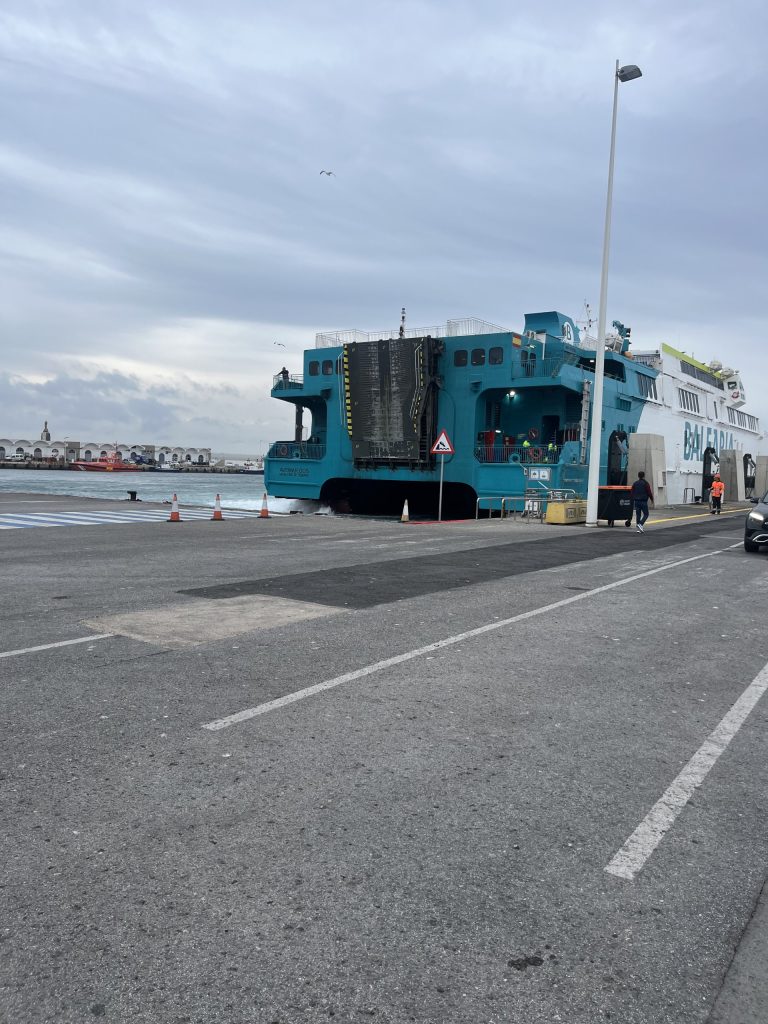
Europe gradually shrank behind me into the growing darkness as the ferry rolled and lurched from wave crest to trough, ensuring everyone on board navigated their way to their seats as if drunk, grasping for handrails and making awkward dashes between fixed objects in a bid to remain upright.
This isn’t a crossing, however, that allows for relaxation, regardless of the sea conditions. Moroccan passport control is actually done on board and with a good few hundred passengers on today’s sailing it’s a chaotic and, for an Englishman hardwired to follow the etiquette of queuing, a rather stressful process.
I’d been handed a small white form upon boarding, a little immigration slip, and amongst a sea of people just as frantically jostling for space as the sea outside, I attempted to fill it in, using my knee as a table. A combination of wave action and stumbling elbows made this harder than it ought to have been but it was one question in particular that made completion difficult. One that, despite having crossed more borders than I care to remember, I still haven’t managed to come up with a particularly satisfactory answer to.
The usual ones – name, address, why I’ve come to Morocco (I was tempted to put to suffer in the mountains of my own free will but resisted) – are easy to answer but occupation, well, that one always gets me.
What, exactly, is my occupation? I honestly never know what to put here. What is it that I do? Traveller? Adventurer? Writer? Vagabond?
None of them really sum up what I do and most, I doubt, constitute a real job so in the end I put what I normally do, cyclist, in the hope that that somehow counts as a job.
It quickly became apparent that an orderly queue was never on the cards and as person after person pushed in front of me I realised I’d have to be a little less British about things if I was to receive a passport stamp any time soon and did my best to hold a position that didn’t mean going backwards.
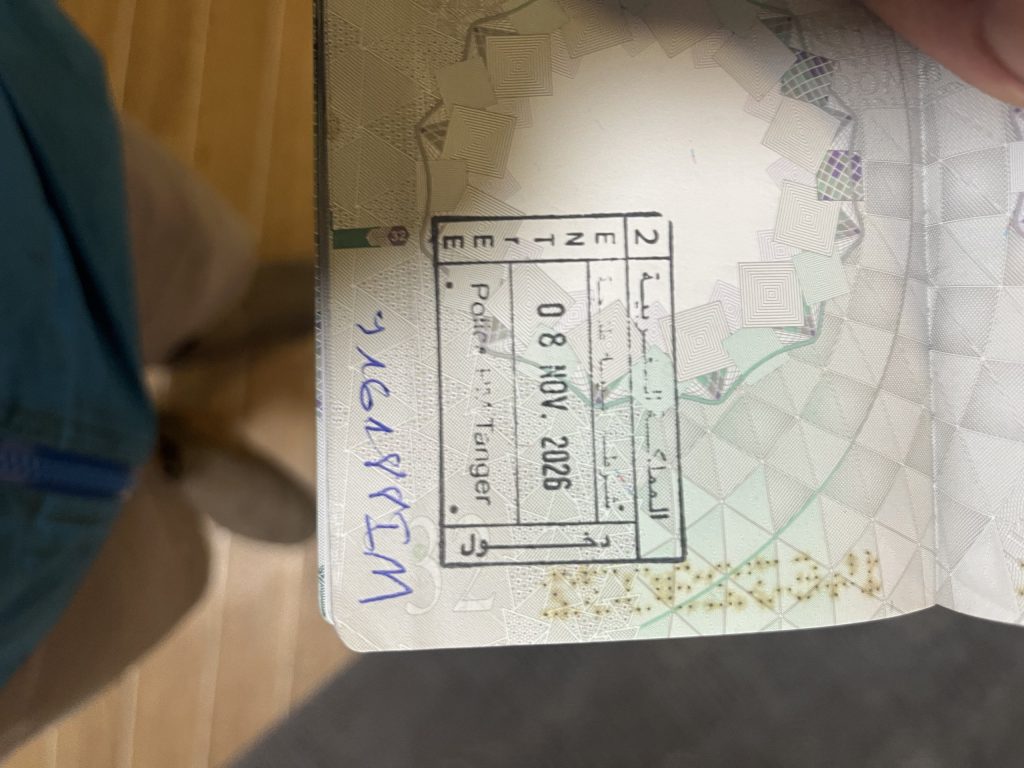
When I did eventually reach the little booth and handed over the card and my passport, it took just a cursory scan of my responses by the official before I was asked to clarify what I did for a living. ‘I cycle,’ I replied, to raised eyebrows. Surely I wasn’t the first to explain such a thing when entering a cycling mecca such as Morocco. For a second it seemed he wasn’t convinced that it qualified as a suitable occupation but, with a glance at the mass of people behind me all yet in need of his approval, he stamped the passport, scribbled some letters next to it and handed it back to me. I, a cyclist, had my first African stamp in my passport.
The usual madness descended when, just twenty minutes later, the announcement came that we were shortly to arrive. I never understand the mentality here. Everyone goes for the same doorway at once, determined to beat the next person through it as though the ship were on fire. Bags are squeezed through past contorted legs, children all but thrown overhead to waiting outstretched arms as if being last off the ferry was sure to bring shame. Remember at school when you used to race friends with a shout of ‘last one to finish is a loser’? Well, disembarking this ferry to Morocco was just an adult’s version of that.
And things got no better once below deck. The second the ferry’s bowels opened and the ramp dropped, the horns began, signalling the start of one of the crazier disembarkations I’ve ever witnessed. Those furthest from the exit suddenly seemed enraged they weren’t off the boat already. Cars inched forward into spaces that barely existed. Bumpers kissed as vehicles made a bid for quicker freedom. The neat rows of cars quickly became a mess as drivers inched sideways left and right in a bid to find a lane that was moving quicker, inevitably causing longer delays. Cars tried desperately to occupy the same space, drivers flailed their arms from windows and the noise and exhaust fumes were almost overwhelming. I opted to remain safely to one side, hugging the wall, and watched the chaos unfold, happy to be the loser that left last.
Eventually, taking far longer than it should have if people had actually just waited their turn and allowed the car in front to go first, the ferry emptied out and I was left to push the bike down the ramp and onto African soil.
Darkness had fallen during the crossing and the rain had set in. Planning this trip, I had the image that I’d arrive in Morocco to heat, ideally in daylight. This wasn’t that.
A sea of red taillights spread out in front of me, sparkling in the rain and all snaking towards the same set of grand stone archways that marked border control. Passport control may have been dealt with on the boat but customs still needed to be done. I joined the queue only to be ushered forward moments later, no doubt to the annoyance of the same drivers who’d battled to beat me off the boat, by some of the smartest-dressed border officials I have ever seen. Only those in Vietnam came close.
I’ve never really understood why immigration officials are the way they are. It is a rare immigration official indeed that has greeted me warmly or with a smile. Most just appear plain annoyed I’ve come to their country at all. They are nearly always awkwardly stern, bordering on angry and unpleasant. It’s always struck me as strange.
The very first person you meet upon entering a new country is often an immigration official, and indeed the first impression you have of its people comes from immigration. Why then aren’t they smiling and welcoming? Why don’t they say, ‘Hey Sam, how lovely to see you, thank you so much for coming to visit us, we’re so pleased you’re here. Perhaps you’d like a coffee? I’m sure you’ve had quite the day’ How much nicer would that be, eh?
But no, they stare at you and make you feel as if you’ve definitely done something wrong already and are determined to find out what you’re up to. I’ve also come to accept that I just have one of those faces that irks immigration officials.
I am almost guaranteed to be singled out and questioned at any border. I remember when landing in New Zealand watching as I inadvertently locked eyes through a crowd of people with an immigration official only to watch as he made a beeline through the crowd to pull me aside and question me. I saw no one else stopped in the same manner. In Indonesia, I was the only passenger that left the ferry that evening from Singapore to be berated by an official for seemingly just appearing in the arrivals lounge. To this day I’ve no idea what I did to upset him so but this is just part and parcel of crossing borders for me.
So you can imagine my surprise then when I was greeted with smiles and kind words when it came time to ask me the usual customs questions. Was I carrying drugs or weapons? Seriously, who answers yes to that? Did I have a drone? Morocco has strict rules on these. Why was I here? All asked with a smile and only partial interest in my answers. I was made to empty one bag chosen at random but its contents weren’t of much interest and then, with a smile and a warm welcome to Morocco, I was allowed on my way. I’d officially arrived. This was Africa!
By now the rain had grown heavier and the relatively quiet roads leading away from the port had quickly become crowded with cars, vans, trucks and scooters. My first experience of navigating all this was at a large roundabout upon leaving customs. Cars edged out, forcing those on the roundabout to switch lanes violently or stop entirely, a tactic I presumed was possibly the only way of entering this fast-moving circle of vehicles. There was no chance of just waiting for a gap, one simply never arrived, so using a car as a partial shield I edged out and joined the swirling mass of red and white lights. Somehow I made it around and was spat out onto the correct three-lane road that snakes its way along the coastline of Tangier. I squinted against the rain, constantly having to wipe my eyes whilst all the time trying to look in every direction at once. My bike lights seemed lost and rather useless in a sea of taillights but by hugging the kerb and praying to every god out there I eventually found my turning off into the even busier narrow streets of the city itself.
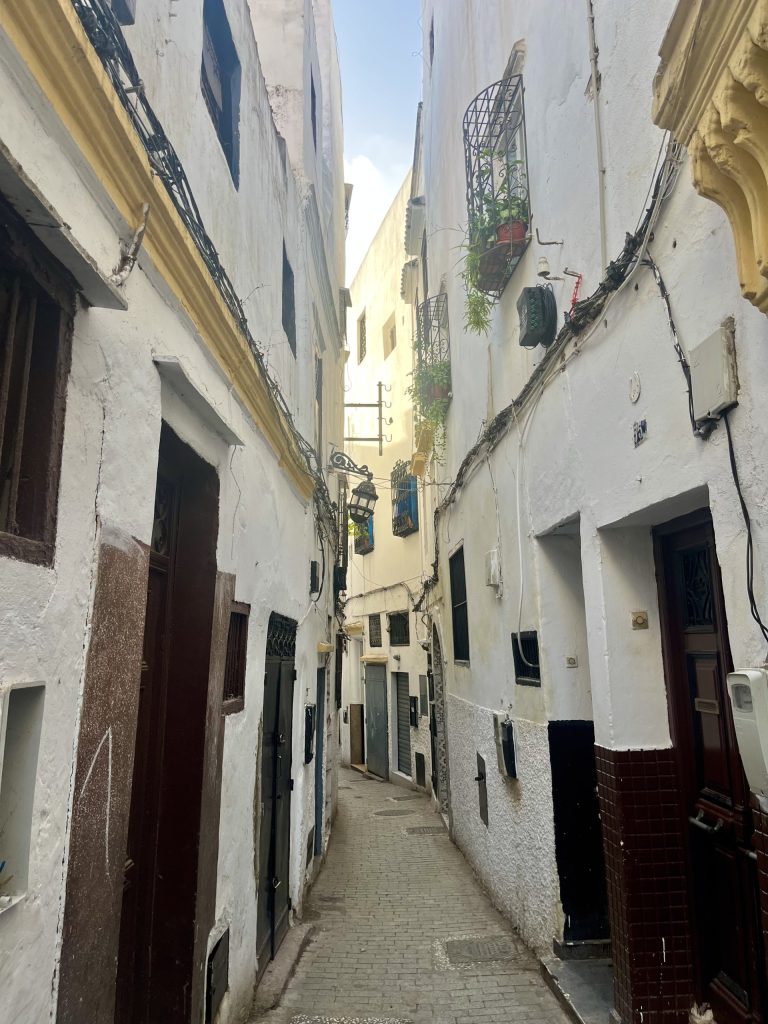
Very slowly I weaved my way through a throng of people and vehicles, past street vendors and roaming street dogs into the old medina. Roads gave way to small lanes and then to alleyways no more than a metre wide in places. Cream-coloured buildings rose up on either side, their metal doors glistening under streaks of moonlight and the occasional street lamp. At times, they formed archways above me, plunging the narrow walkways into darkness. Figures moved from within the shadows, noisily bustling from alleyway to alleyway but paying little attention to me. Eventually, after more steps than I wished to encounter with a heavily laden bike, I found the hostel I’d booked for a few nights and dived inside, glad to be out of both the rain and the madness of medina life.
For the next three days I explored Tangier and slowly got used to the way things work in a city whose old medina was designed and built long before cars. I began to embrace getting lost and allowed myself just to wander the stone alleyways at leisure. Doing so without the bike felt liberating. I discovered little coffee shops, snack bars and street food vendors that all welcomed me as if I was an old friend. I learnt that stepping out into moving traffic was the only way to cross roads, discovered my French was rustier than I thought, my Arabic non-existent, that street dogs and cats seemed to live in a mutual harmony and that for the equivalent of 60p I could get a pretty decent coffee. That last discovery pleased me greatly after Europe.
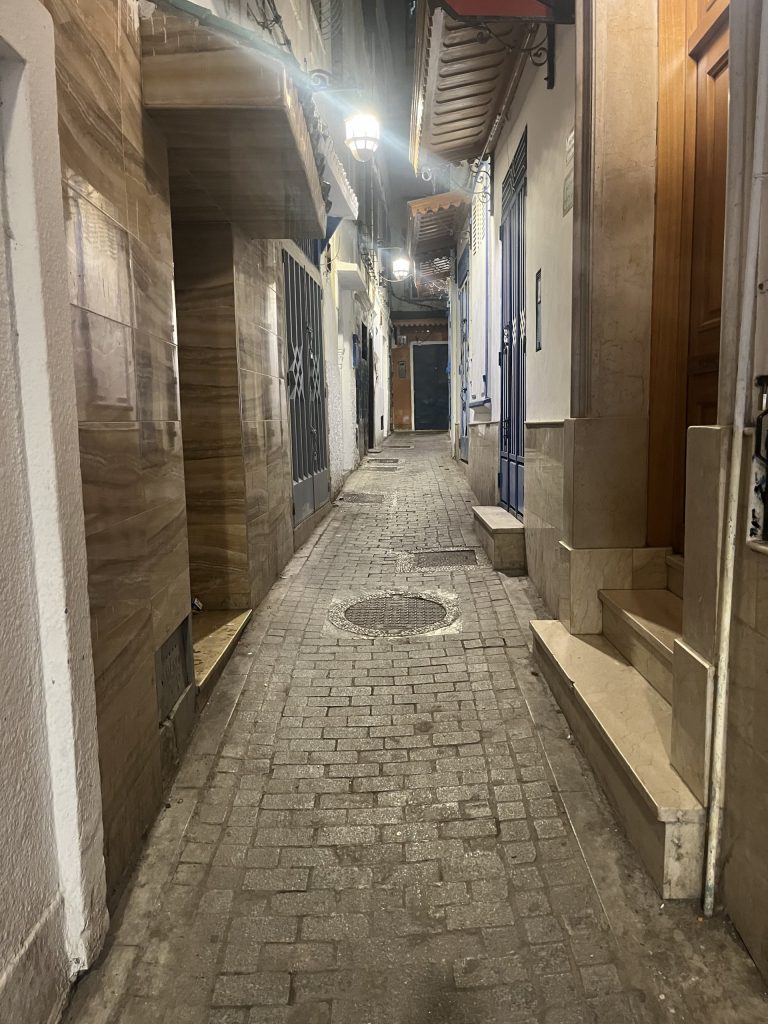
By Thursday I’d cleaned, sorted and repacked all the equipment, stocked up on the basic food necessities and was once more pushing the bike through the medina, apologetically squeezing past crowds of people and avoiding the array of differing wares laid out by street vendors and sleeping dogs. After once again dragging the bike up stairs and coaxing it through alleyways only just wide enough to fit, I found myself back on the roads proper and making my way out of the city, towards a route I’d heard about for years, watched countless videos on and studied in awe more photos of than of perhaps any other route. I was about to start the Route of the Caravans.
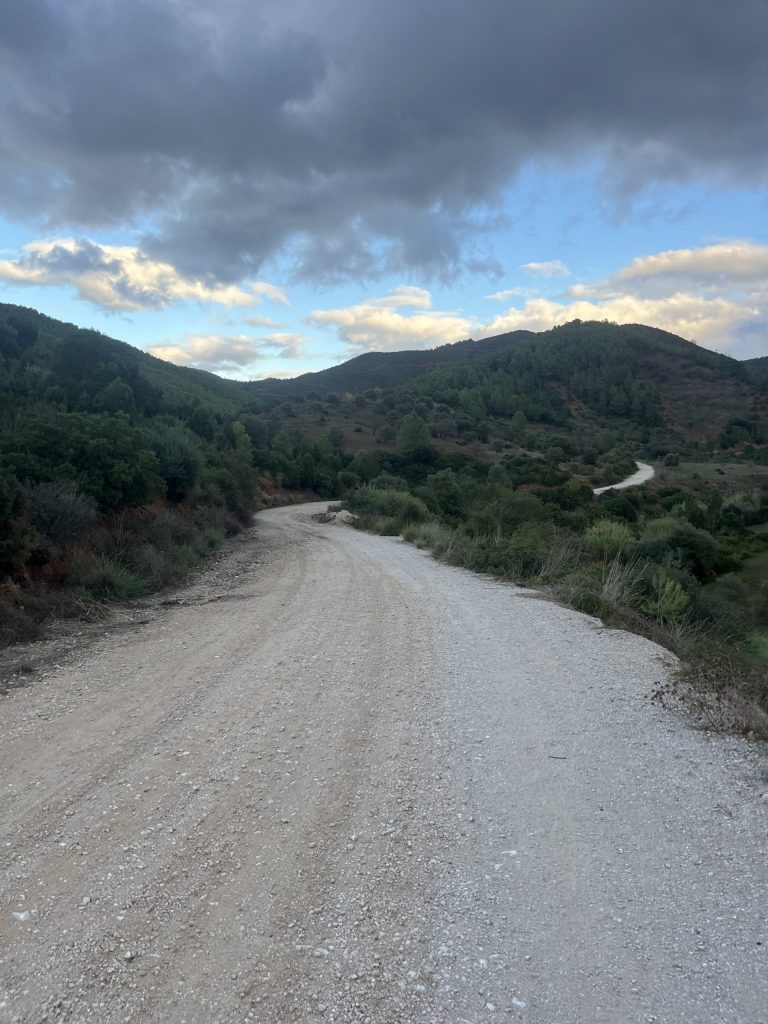
This world-famous bikepacking route runs through the mountains of Morocco for more than 2,000 km and features a momentous 34,000 m+ of climbing. It’s designed to be ridden south to north but I’d be attempting it from north to south. I’d also be doing it during winter and with mountain passes reaching almost 3,000 m high to get over, that brought the worry that if the snow arrived before I did in the High Atlas Mountains, I may not be able to cross over. I’m determined to try but I’m at least three weeks away from the highest point of the route, meaning at the earliest it’ll be mid-December and if previous years are nothing to go by, the first winter storms may have already arrived by then.
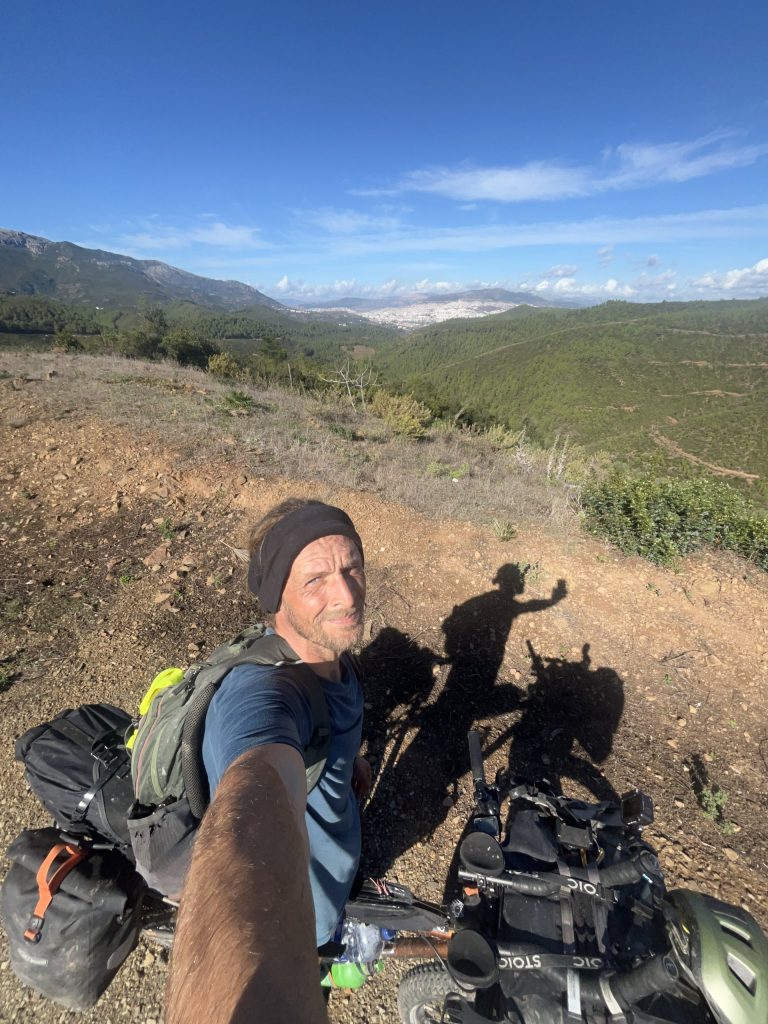
To be honest, it felt a little like winter even now. For the last few days, as I have slowly wound my way up into the Rif Mountains, the first of the mountain ranges I’ll encounter on my way towards the High Atlas, it has barely stopped raining. A big portion of this route is on tracks and trails and they have become more and more difficult to ride as the rain turns the ground into a peanut butter-style mud that sticks to everything, clogging up the wheels, brakes and gears. I’ve been pushing more than I ought to just because traction is so poor, the back wheel constantly just spinning out on me. The rain has become so problematic at times that it’s begun to affect the electronics and the power bank I depend on has decided to stop working. I can only presume water damage somehow. It has been a trying and testing start to the route but better weather is promised and I can only hope the forecast is right.
The city of Tetouan passed by under thick cloud and relentless drizzle and I write these final lines camped up in the hills just south of the city. It’s still raining and most of what I own right now is damp, if not outright wet.
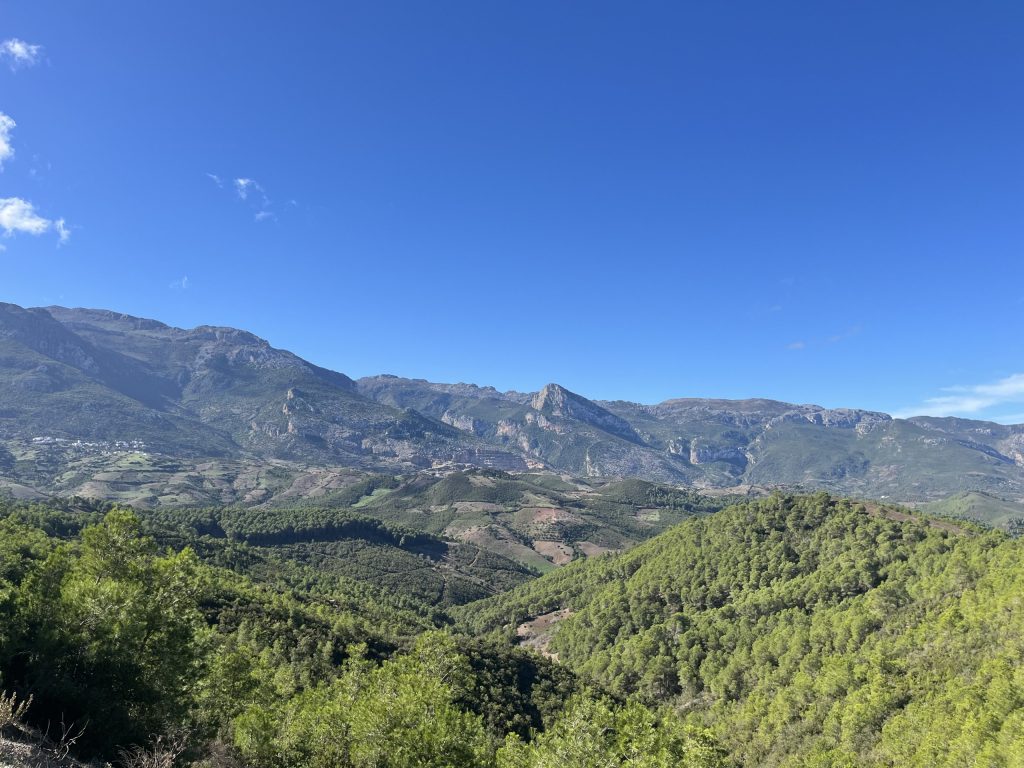
This is not the start to Africa I had imagined. This is a challenging route to tackle in its entirety even in good weather but I’m determined to push on. The rewards for doing so don’t lie in bragging rights or heroics but, I hope, will come in the form of getting to experience for myself the beautiful landscapes that have captured my attention for years through the photography of others.
But I’m also here for the challenge, to test myself once again and see what I’m capable of. Can I still really cycle, push and drag my bike that carries my entire worldly possessions across another mountain range or is that something now confined to my past? And even if I can, will the rapidly approaching winter stop me in my tracks and force a retreat?
There really is only one way to find out, to press on and take it day by day, climb by climb, metre by metre. It would just be nice if the sun returned.
Enjoyed the read? Scroll down to see how you can say thanks and keep the wheels turning