There is something slightly absurd about being back at ‘home’ and still full-time bicycle traveling, packing my entire life away every morning. Most people, when they return home after months away, probably enjoy the simple things. A bed. A shower. A kitchen. Somewhere to leave their belongings without first checking whether an inquisitive fox has taken an interest in them or if the rain is about to make everything soaked and life much harder.
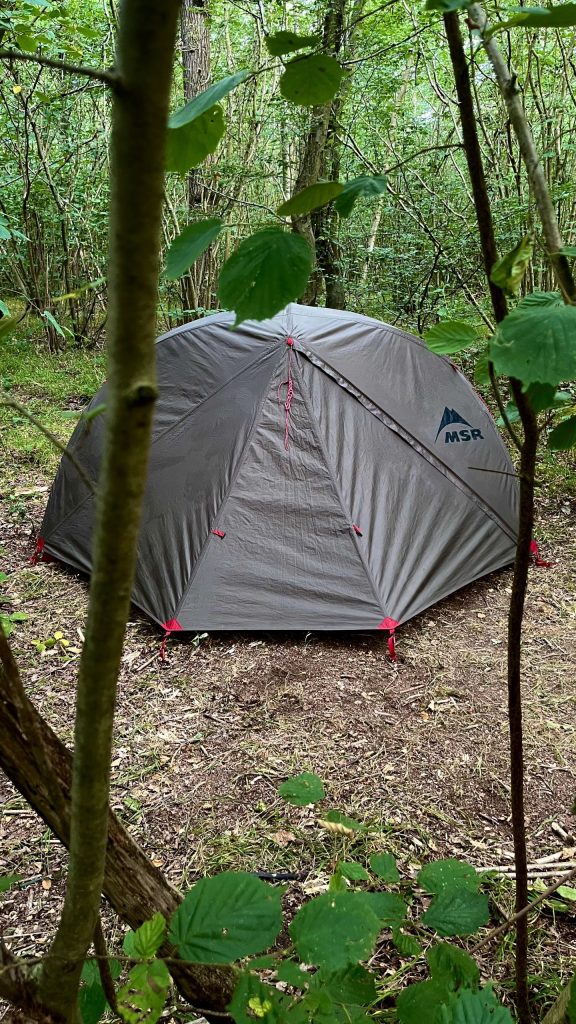
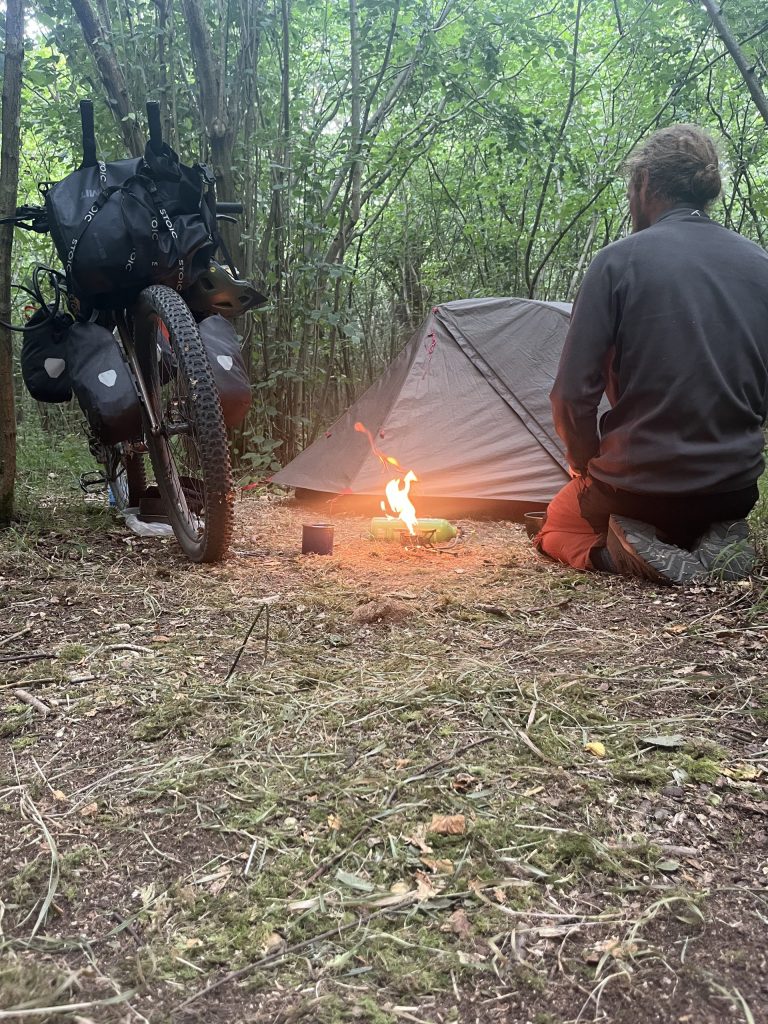
Life for me, though, continues much as it does when on the road proper. Just as I like it. Each morning the sleeping bag gets stuffed away. Mat rolled. Tent collapsed. Everything squeezed back into panniers in an order that has become so familiar I barely need to think about it. I don’t want departure day to feel like starting again. I want it to feel like continuing. Then I disappear from the woods as quietly as I arrived.
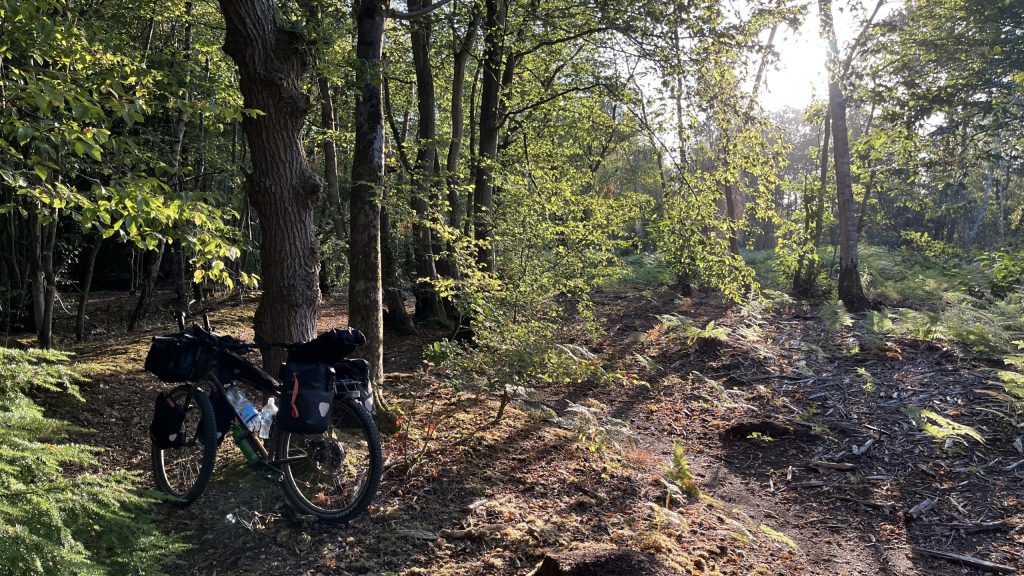
Wild camping close to somewhere as busy as where I am requires a slightly different approach to camping in the middle of nowhere. Out on a remote mountainside, the chances of somebody wandering past the tent are fairly slim. Here, there are walkers, runners and cyclists moving through the woods from surprisingly early in the morning. So remaining quiet and unseen is paramount to my evening and morning routine.
There have been mornings when people have passed remarkably close without realising I’m there at all. I can hear conversations drifting between the trees, bicycle tyres crunching over dry ground and dogs investigating everything except, thankfully, me. I sometimes lie there completely still, listening to somebody walk past only a short distance away, wondering if this is still wild camping or whether I have accidentally become a woodland fugitive in my home town. Either way, it seems to be working and I still love the woods at night. The peace and quiet that comes when darkness falls always makes me feel welcome and safe.
Feeling The Heat
The bigger challenge recently has been the heat. Southern England seems determined to produce one heatwave after another, which is wonderful if your main responsibility is sitting beside the sea with something cold in your hand. It is slightly less convenient when your home is a small tent.
By the end of the day the ground is warm, the air is warm and everything I touch seems to have spent several hours absorbing sunlight. Crawling into the tent in the evening does not provide much relief. Long after darkness arrives, the heat remains trapped inside and sleep becomes more a matter of waiting for the temperature to become more conducive to sleep. The sleeping bag remains stuffed in its sack most nights as I lie there spreadeagled watching the hours tick by in a sweaty haze.
Water has once again become one of the things that occupy my mind more and more. How much can I afford to use before tomorrow? Rationing water is nothing new to me, but doing it in England still feels slightly ridiculous. This is a country where rain has interrupted a significant percentage of my plans over the years. Yet recently I’ve found myself carefully judging each evening how much is left in each bottle before deciding whether I can afford another drink or whether it’s best to just lie there and wait for morning.
Washing has become similarly improvised. Rivers provide one option, using biodegradable soap and keeping things as simple as possible. The sea, only a few miles from my camps, provides another. Swimming has become both a relief from the heat and a fairly effective way of convincing myself I’ve washed. And then there are the cold showers on the beach.
Cold showers normally require a certain amount of mental preparation.
At the moment they are a welcome addition to my mornings and evenings.
Cheap Living
Food remains another daily calculation. It’s so easy when back ‘home’ to let food budgets go out the window. Friends offer dinner dates at restaurants, coffee shops tease with ice-cold offerings that tempt me almost daily and local cafes display mouthwatering advertisements of full English breakfasts and roast dinners, two of the meals most likely to make me buckle.
I’m trying to keep everyday spending below £5, which turns visiting supermarkets into something approaching competitive sport. The reduced section is usually the first destination. I have, over the past few weeks, determined with a good rate of accuracy when shops start to reduce items and time my visits accordingly.
There is a particular satisfaction in finding something useful marked down to a fraction of its original price, especially when the alternative is paying several times as much for exactly the same thing a few aisles away. It does mean dinner is sometimes dictated less by what I fancy and more by what the supermarket has decided it no longer wants. That is fine. Food is food and I’ve never been a fussy eater. Life on the bike has taught me that hunger improves most meals. A successful supermarket visit means enough food for the evening and following morning without doing too much damage to the budget. A particularly successful one means finding something I can carry for another day as well.
The difficulty, as always, is reminding myself whilst in the aisles that everything bought has to go somewhere on the bicycle. There is no kitchen cupboard. No fridge. If I buy it, I carry it. That tends to focus the mind.
The Office
A slightly ridiculous amount of my life is currently taking place in the library.
It has become my temporary office. There are websites to finish, routes to research, visas to understand, equipment to compare, emails to send and an ever-growing collection of lists containing things I need to do before leaving. Each time I tick something off that list, it seems I add two more.
The library provides electricity, internet and somewhere I can sit for hours without being expected to continuously buy coffee. It is almost luxurious and a welcome break from the heat. Except for one thing. The bike is outside.
I have spent years leaving the bicycle in all sorts of places around the world, yet locking it outside somewhere for several hours still makes me uncomfortable. Almost everything I currently own is either attached to it or packed into it. So while I sit inside staring at a computer screen, part of my brain remains outside checking on a bicycle I cannot see. Every unfamiliar noise becomes suspicious. Every time I leave the desk, I glance towards the door. I realise this is probably not the most efficient working arrangement.
Nevertheless, I have spent an unholy number of hours there this week.
The List
The reason is simple. Africa is getting closer. There is now a workable list, not just a jumble of thoughts in my head. Actually, there are several lists.
The bike needs attention. Parts need replacing. Things need checking. Spares need deciding upon. Then there is everything I carry. What stays? What goes? What is useful enough to justify its weight? What am I carrying simply because I have always carried it? I have packed and unpacked the bike enough times recently that I can do it blindfolded. Everything comes off, gets spread out and judged for its worthiness. I stare at the ever-decreasing pile, remove something and convince myself I never had it in the first place. Then several hours later I decide that perhaps the thing I removed was important after all and the whole process begins again.
The aim for Africa is to take the absolute minimum I genuinely need.
That is easier to say than achieve. Long journeys encourage you to prepare for every imaginable problem. The trouble is that preparing for every imaginable problem results in carrying enough equipment to solve problems that may never exist. Africa will require some compromises. I just need to work out which ones.
Fuel Issues
Even something as simple as getting petrol for the stove has managed to become unnecessarily complicated. My stove runs primarily on petrol, which is useful almost everywhere in the world because petrol is not exactly difficult to find. Unless, apparently, you want somebody at a British petrol station to put a small amount of it into a stove fuel bottle. Then things become more interesting. Normal filling stations are rarely willing to fill it, turning what should be one of the easiest jobs on the list into another small problem to solve.
These are the parts of preparing for a large journey that rarely make it into the grand description. “Cycling to Cape Town” sounds dramatic. “Trying to convince somebody to sell me a tiny quantity of petrol” slightly less so.
The Temptation To Leave
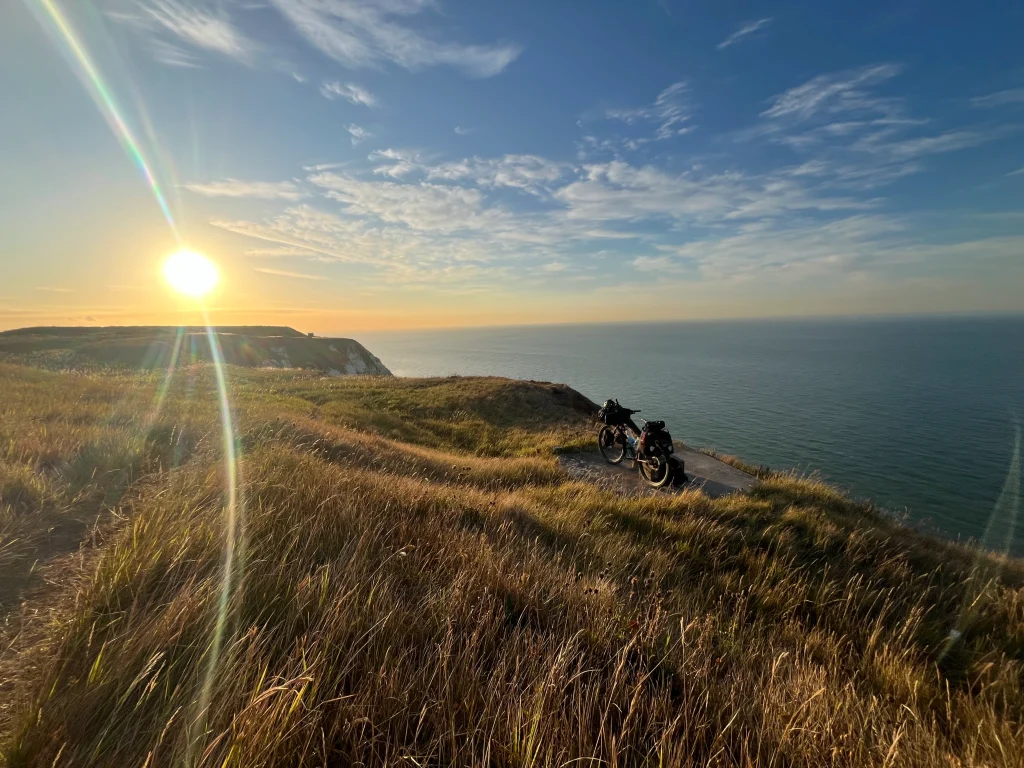
The hardest part of this week has not been the heat, the water or even the endless lists. It has been staying here. Every part of me wants to leave. The bike works. I’m living from it already. France is not very far away. There is an increasingly persuasive voice in my head suggesting that I could simply point south and deal with everything else as I go. It would not be the first time a trip started in that way.
There is a great temptation with big journeys to believe that departure itself will solve the uncertainty. Once you start moving, decisions become simpler because you have committed to a direction. But Africa is too big to treat entirely like that. I don’t need every answer before I leave. I don’t even want every answer. But I do feel like taking the time to be properly prepared is worth doing. There is a difference between embracing uncertainty and being careless.
Saying It Aloud
Something else has changed this week. I have started telling people of my plans. Not everybody and not too loudly. But the words Africa and Cape Town are beginning to appear in conversations. That makes everything feel considerably more real.
An idea inside your own head is easy to change. You can abandon it without explanation. Once you start telling friends and family that you intend to cycle from Canterbury to Cape Town, the idea seems to gain weight.
Suddenly it exists outside you. People ask questions. When are you leaving? Which way are you going? How long will it take? Is it safe? Some of those questions I can answer. Some I cannot. That is probably a useful reminder of how much work remains.
Mapping The Future
The maps have started appearing too. For now, I am only beginning to look properly. South through Europe. Morocco. Then the enormous stretch of Africa beneath it. Countries that previously existed as names on a map are slowly becoming routes, borders and decisions. I find myself following roads south, wondering where water might become difficult, where mountains interrupt the obvious line and where another route might offer something more interesting.
This is the stage I love. The map still contains almost unlimited possibility. Nothing has gone wrong yet. No road is closed. No border official has said no. No headwind has spent four consecutive days attempting to push me back to the UK. On paper, everything works beautifully. Reality will have its say later. It’s this that separates a holiday from an adventure. The unknown.
It’s Happening
Africa no longer feels like a hypothetical next journey. It feels like something that is actually about to happen. And with that comes the familiar fear.

Can I afford it? Have I prepared enough? What happens if something goes badly wrong? What if a border closes? What if the bike fails? What if I do? The mind is remarkably good at producing problems for journeys that have not even started. I have learned over the years to let those thoughts arrive and then move them aside. Not because things never go wrong. They do. But far more often, things go right. A route appears. Somebody helps. A problem gets solved. The next town has water. The road continues. And eventually something that once looked impossibly distant becomes the place you are standing. For now, I just have to keep preparing. Which, somewhat frustratingly, means staying exactly where I am.