
Overview

Best Time
May – September

Duration
1 – 2 Days

Terrain
Tarmac / light gravel

Difficulty
Easy

Challenges
Weather

Best Bike
Any Bike
Guide Contents
Small, slow and wonderfully laid-back, Gigha is a bikepacking destination where white-sand beaches, turquoise water and quiet single-track roads matter far more than big miles or technical trails. Whether you’re looking for an easy introduction to island bikepacking or somewhere to slow down after a bigger adventure, this tiny island off the Kintyre Peninsula is surprisingly hard to beat. This Gigha Bikepacking Guide aims to help you get the most out of your visit.

The Isle of Gigha doesn’t tend to feature on most bikepackers’ destination wish lists and, sure, it isn’t exactly a Mecca for those looking for adventure, but I’d argue it shouldn’t be entirely overlooked.
Gigha might lack the size and trails for a standalone bikepacking adventure, but it lends itself rather well to combining with a wider island-hopping tour, or simply as somewhere to recuperate after a bigger adventure.
It’s also a perfect beginner destination. For anyone looking to introduce a younger generation to the joys of gravel riding and wild camping, without the isolation and hill climbs found on many other Hebridean islands, Gigha is hard to beat.
At only around seven miles long, any route you choose is never far from civilisation. Yet its quiet single-track roads, turquoise water, white-sand beaches and views towards Jura and Islay from the western shoreline can make it feel far more remote than it actually is.
So, whether you’re in need of some downtime after an epic gravel adventure on nearby Kintyre or Islay, or visiting simply to experience the island’s quiet pace of life and stunning landscapes, this guide aims to give you everything you need to plan your visit and get the most from one of the most laid-back bikepacking destinations in Scotland.
About this guide
This guide is built from first-hand experience. Most of it comes directly from notes I made while riding and camping around Gigha — often late at night in the tent, after experiencing the routes, weather and logistics described below.
Where information didn’t come directly from me, it came from other bikepackers I met on the island or from later first-hand contributions. This isn’t generic destination information copied together from around the web. Where practical details needed updating — such as ferry information, opening times or current services — I’ve checked them against current operator or business information.
Details such as prices, ferry timetables and opening times can change. Everything was accurate to the best of my knowledge when published, but if you spot a mistake, have an update or think something is missing, please get in touch.
Affiliate disclosure: Some links on this page are affiliate links. If you make a booking or purchase through one of them, FTtouring may earn a small commission at no extra cost to you. I only include links where they are relevant and useful to planning the trip.
When to Go
Late spring through to early autumn is the best time to explore Gigha by bike, although unlike many Scottish bikepacking destinations, I’d happily put summer right at the top of the list.
Small, low-lying and exposed to the influence of the Atlantic, Gigha generally has a milder climate than many parts of western Scotland. There are no big mountains to contend with either, which means even on warmer days you’re not going to be spending hours grinding your way up long, sweaty climbs.
Spring is arguably when the island looks its prettiest, with fresh growth returning to the trees, bluebells appearing along the roadsides and woodland glens, and gorse bursting into yellow flower. The days are getting longer, businesses begin reopening after winter and the worst of the summer midge season is still to come.
But if there’s one place where I’d make an argument for bikepacking in the middle of a Scottish summer, it’s Gigha. On a warm, sunny day, its white-sand beaches and clear turquoise water can look more like the south of France than western Scotland. Add a bike, a quiet beach and nowhere in particular to be, and it’s very easy to lose an afternoon here.
The trade-off is that summer is the busiest period. Accommodation and the island’s small campsite can fill, while midges can make themselves known once the wind drops in the evening.
Early autumn can offer another good window, particularly once visitor numbers begin to fall and the midges become less active. By winter, however, Gigha becomes much quieter. The campsite availability becomes more limited and cafés, restaurants and other seasonal businesses operate reduced hours, making it a far less convenient time for a bikepacking visit.
Bike & Packing Recommendations
Gigha lends itself perfectly to almost any style of bike, and the old adage that the best bike is the one you already have feels particularly appropriate here.
A gravel or touring bike will probably give you the most flexibility, especially if you plan to explore the island’s network of gravel paths and farm tracks, but you certainly don’t need anything specialised. Most of the gravel is compact and smooth enough that I’d happily ride it on road tyres, although a little extra width will make the rougher tracks more comfortable. A decent, fully charged e-bike should also have more than enough range to explore an island this small.
Your luggage setup can be equally simple. Unless Gigha forms part of a longer tour, there’s little reason to arrive carrying a full expedition setup. As always, the lighter you are, the more enjoyable the riding tends to be. Pack, repack and then pack again — you’ll probably be surprised by how much you don’t actually need.
Recommended for Gigha:
- Waterproofs
- Midge repellent or a head net
- Tick remover
- Basic tool and puncture-repair kit
- A warm down or insulated jacket
- Water filter
- Sun cream
- Power bank
- Swimming shorts
Getting To/From Gigha
Despite being an island, getting yourself and a bike to Gigha is remarkably straightforward. There’s only one ferry route to worry about, the crossing is short and regular, and bikes travel free — meaning the logistics of reaching Gigha are almost as laid-back as the island itself.
From Mainland Scotland:
The main way onto Gigha is by ferry from Tayinloan on the Kintyre Peninsula to the ferry slip at Ardminish. The crossing is operated by Caledonian MacBrayne (CalMac), takes around 20 minutes and, for anyone arriving by bike, is about as straightforward as island travel gets.
The route operates several times a day and is run as a Turn Up and Go service. Tickets can be bought in advance or when travelling, although it’s always worth checking the latest timetable before setting off. Bad weather can disrupt the service and crossings can occasionally be cancelled at short notice. You can view CalMac’s timetable and current fares here.

As of the 2026 summer timetable, an adult passenger fare is £3.70 each way, while bicycles travel free. That makes a return trip with your bike just £7.40.
If you’re incorporating Gigha into a longer tour, Tayinloan sits directly on the western side of the Kintyre Peninsula, making the island particularly easy to combine when riding the Kintyre Gravel Way route rather than treating it as a standalone trip. You can view our guide to the Kintyre Gravel Way here.
Back to the mainland
There isn’t really a choice to make here. When it’s time to leave, you simply retrace your journey and catch the ferry from Gigha back to Tayinloan.
Because the island is so small, Ardminish and the ferry slip are never particularly far away. That makes Gigha refreshingly simple logistically: there’s no need to plan your final day’s riding around a long dash across the island just to make the boat.
Weather
Gigha is exposed to Atlantic weather systems, but without the mountains found across much of western Scotland, you don’t have quite the same potential for harsh conditions at altitude. That doesn’t mean the weather should be underestimated, though. Wind is probably the biggest thing to watch, particularly on the island’s exposed coastline.
Gigha is also one of the few Scottish islands where I’d genuinely recommend summer as perhaps the best time to visit. Sure, the midges might be out in force once the wind drops in the evening, but spending a lazy summer afternoon on one of the island’s white-sand beaches, swimming in clear turquoise water while the sun is shining, is worth the odd bite.
Couple that with the fact there’s barely a hill on Gigha long or steep enough to break a sweat, and warm summer weather can turn the island into a bikepacking paradise.
Conditions can still change quickly, as they can anywhere on Scotland’s west coast, so waterproofs should always find their way into your bags regardless of what the forecast says.
Seasonal Breakdown
Spring (March → May)
Spring is arguably Gigha at its prettiest. The island begins emerging from its winter quiet, businesses start reopening and fresh leaves, bluebells and flowering gorse bring colour back to the landscape.
Days are getting longer, conditions are generally improving and you’ll arrive before the worst of the summer midge season.
Typical daytime temperatures:
March: 2–9°C
April: 4–12°C
May: 6–15°C
Summer (June → August)
Possibly the best time to experience Gigha. Long days and warmer weather make the island’s white-sand beaches and turquoise water difficult to resist, and there are few significant climbs to make hot days uncomfortable on the bike. It’s also peak visitor season, though, so book the campsite or accommodation ahead and expect midges when the evening wind drops.
Typical daytime temperatures:
June: 9-18°C
July: 11–20°C
August: 11–19°C
Autumn (September → November)
Early autumn can be a great compromise, with fewer visitors, quieter beaches and the midge season beginning to ease. As the season progresses, days shorten, temperatures fall and Atlantic weather becomes increasingly unsettled. September is the sweet spot; by November, Gigha is beginning to settle into its winter rhythm.
Typical daytime temperatures:
September: 9–17°C
October: 6–13°C
November: 4–9°C
Winter (December → February)
Winter is Gigha at its quietest. Short days, stronger Atlantic weather and limited seasonal services make bikepacking less convenient, while the campsite availability becomes more limited. It’s still possible to visit, but for most riders there are much better times of year to experience the island.
Typical daytime temperatures:
December: 1-7°C
January: 1-7°C
February: 1-7°C
Camping & Accommodation
For most bikepackers, camping is going to be the obvious way to experience Gigha. The island has an official campsite close to the ferry at Ardminish, while its quiet coastline also offers some exceptional opportunities for responsible wild camping. Gigha does have alternatives, including a hotel, B&Bs and a small selection of self-catering accommodation.
Hotels/B&Bs/Self-Catering
For such a small island, Gigha has a reasonable selection of places to stay if camping isn’t your thing, although choices are naturally limited compared with the mainland.
Isle of Gigha Hotel
Address: Ardminish, Isle of Gigha, PA41 7AA
Tel: 07988 359477
Website: Isle of Gigha Hotel
The island’s main hotel is undergoing a phased refurbishment, with five bedrooms currently reopened and available to book. Its central Ardminish location also puts food, the shop and ferry within easy reach.
Achamore Lodge B&B
Address: Achamore, Isle of Gigha, PA41 7AA
Tel: 07791 749945
Two guest rooms, which are booked together as one family unit, with breakfast included. It’s particularly convenient for Achamore Gardens.
Achavinish B&B
Address: Achavinish, Isle of Gigha, PA41 7AA
Website: Achavinish accommodation
A farmhouse B&B overlooking the Sound of Gigha, with a private guest entrance and continental breakfast delivered to the room.
Gigha Holiday Lets
Address: Isle of Gigha, PA41 7AA
Tel: 07538 435628
Website: Gigha Holiday Lets
This covers five separate cottages. Ferry Croft 1 and Ferry Croft 2 are near the ferry terminal, while The Byre, The Barn and The Stable are at the Drumachro Steadings near Achamore Gardens.
Wee Isle Cabin
Address: Tarbert Farm area, Isle of Gigha, PA41 7AA
Tel: 07500 116349
Website: Wee Isle Cabin
A small self-catering cabin sleeping up to four, with views across the northern and western side of the island.
3 Ardminish – Ardminish Village House
Address: Ardminish, Isle of Gigha, PA41 7AA
Booking: Airbnb
A two-bedroom house in the middle of Ardminish, with the island’s main facilities within roughly a ten-minute walk.
9 Ardminish
Address: Ardminish, Isle of Gigha, PA41 7AA
Tel: 01546 603650
Website: 9 Ardminish
A three-bedroom holiday house around a mile from the ferry slip, with an enclosed garden and Wi-Fi.
South Drumachro Farmhouse
Address: South Drumachro, Isle of Gigha, PA41 7AA
Booking: Hideaway Holiday Lettings
A secluded three-bedroom farmhouse around two miles from the ferry slip.
Ceol Mara House
Address: Ardminish, Isle of Gigha, PA41 7AA
Booking: Hideaway Holiday Lettings
A three-bedroom house sleeping six with room in the garage for storing bikes.
Beach View Cottage
Address: Isle of Gigha, PA41 7AA
Tel: 07776 023246
Booking: Hideaway Holiday Lettings
Sleeps up to six and, unusually for self-catering accommodation, one-night stays are available, which potentially makes it one of the more practical options for a bikepacker making a short Gigha visit.
The Yurt Experience
Address: Isle of Gigha, PA41 7AA
Booking: Airbnb
A handmade yurt sleeping up to four, with proper beds and a wood-burning stove. It’s a nice halfway house for someone who likes the idea of camping on Gigha but doesn’t want to carry a tent and full sleeping setup.

Campsites
Camping is probably the most natural way to experience Gigha, and if you want a few more comforts than wild camping provides, the island has one excellent official campsite. Conveniently located close to the ferry, it makes an easy base for exploring the entire island while still retaining much of the peace and simplicity that makes camping on Gigha so enjoyable.
(All information correct as of May 2026)
Ardminish Bay
Isle of Gigha Camp & Motorhome Site
The campsite sits beside Ardminish Bay, only a short distance from the ferry slip. The pitches are vehicle-free and tucked among bracken, long grass and wildflowers, giving considerably more privacy than you’ll find on many conventional campsites.
Facilities include hot showers, toilets, a covered washing-up and seating area, and a small camp kitchen with a kettle, microwave and charging points.
As of 2026, prices start at £15 per night for a small tent pitch with one person, with medium pitches from £23 and larger pitches from £25.
Contact Details:
Address:
Ardminish Bay, Isle of Gigha, PA41 7AA
Website:
Phone number:
07985 566004
Wild Camping
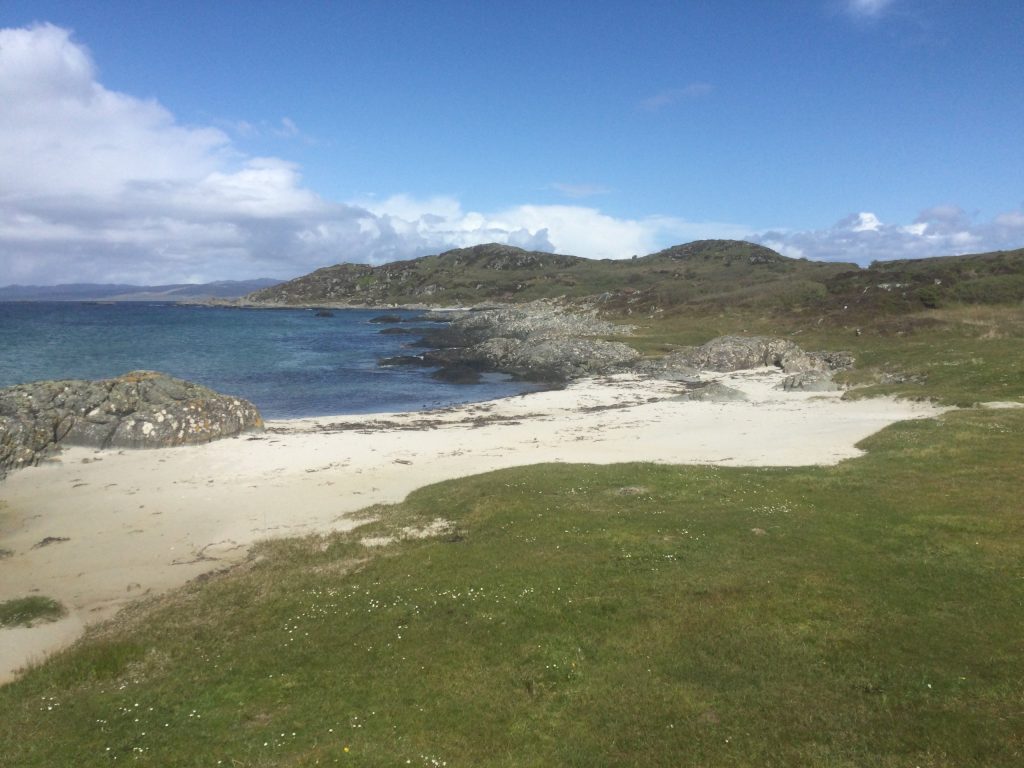
Wild camping is one of the real highlights of bikepacking on Gigha. Despite the island’s small size, there are some beautiful places to spend the night, particularly along the western coastline, where quiet bays, white-sand beaches and views across towards Jura and Islay make it surprisingly easy to find somewhere you won’t want to leave.
My favourite is around Twin Beaches, which is one of the best places I found for a night or two on the island. As well as being a spectacular place to camp, its position can offer some shelter from the prevailing south-westerly winds. In summer, choosing a coastal pitch also gives you a better chance of catching enough breeze to keep the midges at bay.
As elsewhere in Scotland, wild camping should be lightweight, responsible and carried out in line with the Scottish Outdoor Access Code. Keep well away from homes and working land, avoid blocking access, leave no trace and move on if a spot clearly isn’t suitable.
Food & Resupply
Resupplying on Gigha is straightforward, although almost everything is concentrated around Ardminish. With only one proper shop on the island, it’s worth bringing anything particularly important with you from the mainland.

Ardminish Stores & Post Office
This is the island’s main shop and the obvious place to resupply. It stocks everyday essentials including bread, dairy products, fruit and vegetables, fresh and frozen food and a selection of locally produced goods. The range is naturally smaller than a mainland supermarket, but for a day or two of bikepacking you should have no trouble finding enough to keep yourself fed.
Honesty Boxes
A number of locals offer honesty boxes outside their properties selling things such as homemade cakes, pastries, eggs and bread.

Eating Out
The Boathouse
Set right on Ardminish Bay, The Boathouse is Gigha’s main seafood restaurant, with much of the seafood landed locally. There’s indoor seating, heated decking and tables overlooking the beach. Booking ahead is strongly recommended, particularly in summer.
Opening hours: Opening hours are seasonal and can change. Booking ahead is strongly recommended — check The Boathouse directly for current opening days and times.
The Nook
Beside Ardminish Stores, The Nook is a small takeaway specialising in fresh seafood. Depending on the catch and menu, you might find Gigha crab rolls, langoustines, smoked halibut bagels, fish and chips, scallops and other seafood dishes. It’s particularly well suited to bikepackers because you can simply grab something and take it down to the beach. Opening hours change regularly. The latest times are displayed outside the business.
Wee Isle Café
Located at the Craft Units, Wee Isle Café is run by Wee Isle Dairy and is a good daytime stop for coffee, cakes and Gigha-made ice cream. It operates as a takeaway but has indoor and outdoor seating.
Opening hours: Wednesday–Sunday, 11:00–16:00.
Isle of Gigha Hotel Bar & Restaurant
The refurbished hotel gives you another proper sit-down option in Ardminish. The bar opens every day from noon, while the main lunch and dinner menu is currently served Wednesday–Sunday. On Monday and Tuesday, the food offering is limited to soup and sandwiches at lunchtime.
Opening hours: Monday–Tuesday 12:00–20:00; Wednesday–Thursday 12:00–22:00; Friday–Saturday 12:00–00:00; Sunday 12:00–22:00.
Kintyre Fire Pizza
Kintyre Fire brings its wood-fired pizzas across to Gigha as a seasonal takeaway, giving bikepackers another welcome option when it’s operating. Pizzas are made using locally sourced ingredients where possible and are available from Ardminish on Mondays during the season.
Orders need to be placed in advance by Sunday evening, rather than simply turning up on the day, so it’s worth planning ahead if you fancy pizza after a day exploring the island. Check Kintyre Fire’s latest social-media updates before relying on it being available.
Opening: Seasonal — Mondays
Ordering: Pre-order by Sunday evening
Tel: 07876 591299
Collection: Ardminish, Isle of Gigha
Water
Water takes a little more thought on Gigha than you might expect. Unlike many parts of mainland Scotland, there aren’t plentiful burns and streams running down from the hills, so I wouldn’t arrive expecting to fill your bottles from natural sources as you ride around the island.
If you’re staying at the Isle of Gigha Camp & Motorhome Site, drinking water is available there. The campsite also allows non-residents to use certain facilities for a small charge, which can provide another opportunity to top up while passing through Ardminish.
The most useful free water point I found was at The Boathouse. When I asked at Ardminish Stores where I could refill my bottles, they directed me to the freshwater tap used by visiting boats at the pontoons behind The Boathouse. Head around the building towards the sea and you’ll find it by the waterfront.
Ardminish Stores sells bottled water, although supplies and bottle sizes can be limited. On both of my visits, only 500ml bottles were available, so I wouldn’t rely on buying several litres there if you’re heading off to camp.
Away from Ardminish, reliable water sources are much more limited. The island’s residents are incredibly friendly and I doubt you’d struggle to get a bottle filled if you genuinely needed one, but carrying enough water for the day remains the simplest option. If you do collect water from a natural source, filter or treat it before drinking.
Bikepacking Routes on Gigha
Gigha isn’t really an island where you need to follow a predefined bikepacking route. Instead, there’s a collection of short shared-use paths and tracks branching away from the main road, often leading towards beaches, viewpoints and other points of interest before bringing you back the same way.

When you arrive, there’s a small information hut near the ferry with maps showing the island’s path network and which trails are suitable for cyclists. These can be picked up for a suggested £1 donation from the honesty box.”
By linking the cycle-friendly paths with the island’s quiet roads, it’s possible to put together roughly 20km of riding that explores nearly all of Gigha. Most of the dedicated cycling sections I rode were compact, smooth gravel, while some of the farm tracks were noticeably rougher and rockier.
One thing worth remembering is that not every path shown on Gigha’s maps is intended for bikes. Some of the rough tracks and natural trod paths are designated for walkers rather than wheeled users, so check the map rather than assuming every line is rideable.

Cycle Shops & Repairs
There is no dedicated bike shop on Gigha, so it’s worth arriving with enough basic tools and spares to deal with the most common problems yourself. At a minimum, I’d carry a pump, puncture-repair kit or spare tube, tyre levers, multitool and a couple of spare chain links.
If you do run into trouble, Gigha Boats and Activity Centre is probably the first place I’d ask. It’s only a short walk from the ferry slip and operates the island’s cycle-hire service, with conventional bikes and e-bikes available. The staff are used to dealing with bikes, although it shouldn’t be treated as a full workshop or guaranteed repair service.
For anything more serious, you’ll need to look towards the mainland, making self-sufficiency particularly useful if Gigha forms part of a longer tour.
Public Bike Repair Stations
There are no dedicated public bike repair stations on Gigha, so don’t arrive expecting to find one of the fixed tool stands or public pumps found on some larger cycling routes.
Cycling Clubs on Gigha
There are no dedicated cycling clubs based on Gigha. Given the island’s tiny population and limited road network, that’s hardly surprising.
Cycling here is much more about independent exploration than organised group riding. If you’re looking for local advice while on the island, Gigha Boats and Activity Centre is probably the most useful first port of call thanks to its bike and e-bike hire operation.
Bikepacking Highlights on Gigha
Despite its size, Gigha has a surprising number of places worth stopping for. Ancient monuments, subtropical gardens, white-sand beaches and huge views across to neighbouring islands are all squeezed into an island barely seven miles long.
The best part is that none of them requires a major detour. Most can be incorporated naturally into a day spent exploring Gigha’s quiet roads and cycle-friendly paths, leaving plenty of time to slow down and actually enjoy them rather than simply ticking them off a list.

1. Giant’s Tooth Standing Stone
Known locally as the Giant’s Tooth, this solitary standing stone is one of Gigha’s most distinctive ancient monuments. Local legend claims that a giant suffering from toothache pulled out the offending tooth and threw it across the island, where it remains today.
It’s an easy stop to incorporate into a ride and a reminder that, despite Gigha’s small size, there’s considerably more history scattered around the island than you might initially expect.
2. Twin Beaches
If there’s one place I wouldn’t miss on Gigha, it’s Twin Beaches. White sand, clear turquoise water and views across towards the Paps of Jura make this one of the most photogenic corners of the island. The northern end can be reached along a smooth gravel cycle path, making the journey there almost as enjoyable as the destination. It’s also my favourite place on Gigha for wild camping, with some protection from the prevailing south-westerly winds and an incredible spot to wake up when the weather plays ball.
3. Achamore Gardens
Gigha probably isn’t the first place you’d expect to find a collection of subtropical plants, but the island’s mild climate and the sheltered position of Achamore Gardens allow an extraordinary range of plants to thrive here. The gardens include woodland, rhododendrons and walled gardens, while the higher ground provides views towards Islay and Jura. Bikes need to be left at the entrance, so this is one highlight where you’ll have to swap two wheels for two feet for a while.
4. Atlantic Sunsets
You don’t need an entrance ticket or even a particular destination for this one. Find yourself somewhere along Gigha’s western coastline on a clear evening and simply stop riding.
With an uninterrupted horizon across the Atlantic and towards Islay and Jura, the sunsets can be spectacular. Better still, if you’re wild camping on the coast, there’s no need to ride anywhere afterwards — put the kettle on, sit outside the tent and enjoy the show.
5. Gigha’s Dark Skies
Once the sun disappears, there’s another reason to stay outside. The northern end of Gigha is recognised as a Milky Way-class Dark Sky Discovery Site, the highest designation within the Dark Sky Discovery scheme. With very little artificial light and huge open skies, a clear night can produce exceptional stargazing. It’s one of those Gigha experiences that costs absolutely nothing — you just need the clouds to cooperate.
Bikepacking Gigha on a Budget
Gigha can be an incredibly cheap place to explore by bike, particularly if you’re happy to wild camp and cook most of your own food. With the return ferry costing just £7.40 for an adult and bicycles travelling free, there are very few unavoidable expenses once you reach the island.
Wild camp, bring most of your food from the mainland and you could comfortably spend 48 hours on Gigha for under £20 per person, including the ferry and still leaving enough for a coffee or two.
On my own visit in May 2026, I spent three days exploring the island and researching this guide. I wild camped all but one night, picked up supplies from the village store and stopped for the occasional coffee, and still spent less than £40 in total.
That said, Gigha is community-owned, and spending a little money while you’re here genuinely helps support the island. Rather than bringing absolutely everything with you in an effort to save a few pounds, buy something from Ardminish Stores, grab a coffee, order some locally caught seafood or have a meal at one of the island’s independent businesses.
You’ll still have an exceptionally cheap bikepacking trip, while putting a little back into the community that makes visiting Gigha possible.
Safety
Gigha is an extremely safe place to explore by bike. With a population of fewer than 200 people, remarkably quiet roads and a close-knit island community, crime is unlikely to be something you’ll spend much time worrying about.
Traffic is equally limited. On one of my rides I cycled the entire main road from one end of the island to the other without seeing a single car. When vehicles do appear, the usual care is still required on Gigha’s narrow single-track roads, particularly around bends and passing places.
The greater risks here come from the environment. Strong winds and rapidly changing weather can make exposed sections of coastline considerably less comfortable than the island’s gentle terrain might suggest, so keep an eye on the forecast and don’t underestimate how quickly conditions can change.
Mobile reception was generally good during my visits, although I occasionally lost signal along sections of the western coastline. The reassuring thing is that Gigha is so small that you’re never particularly far from Ardminish, the ferry or somewhere you can ask for help.
Perhaps most importantly, I found the people on Gigha incredibly friendly. It’s the sort of place where slowing down, saying hello and stopping for a conversation feels every bit as natural as riding the bike.
5 Things I Wish I’d Known Before Bikepacking Gigha
- The beaches genuinely can look like the south of France
- The night skies are among the best in the country
- Cycling faster than 5mph somehow feels illegal
- Opening hours can be surprisingly unpredictable
- The wild camping may be some of the best in Scotland
Additional Notes – Midges, Wildlife & Ticks
Midges
Midges can be one of the less enjoyable parts of a summer visit to Gigha, particularly during warm, still evenings. In sheltered inland areas, long grass or among vegetation, they can quickly turn an otherwise perfect camping spot into somewhere you’d rather not be.
The best defence is often simply choosing where you camp carefully. Coastal pitches tend to benefit from more breeze, and even a relatively light wind can make an enormous difference. It’s one of the reasons I’d favour camping near the coast rather than heading inland during the main midge season.
Carry a decent midge repellent and, if you’re visiting during summer, a head net weighs almost nothing and can save an evening. Spring and early autumn generally see less activity, although conditions ultimately depend on temperature, wind and weather.
They’re an annoyance rather than a reason to avoid Gigha — just another good excuse to find yourself a breezy beach for the night.
Wildlife
For such a small island, Gigha supports a surprising amount of wildlife, particularly around its long and varied coastline. The quiet shores and sheltered bays are good places to keep an eye out for otters and seals, while dolphins can occasionally be spotted offshore.
Birdlife is particularly noticeable around the coast, with seabirds and waders feeding along the shoreline and in the island’s bays. Away from the water, Gigha’s mix of heath, grassland, woodland and gardens also supports butterflies and common lizards.
As with most wildlife watching, the best approach is simply to slow down and keep your eyes open. Travelling by bike makes that remarkably easy, and Gigha’s quiet roads mean there’s rarely much traffic noise competing for your attention.

Ticks
Ticks are common on Gigha, particularly in long grass, bracken, heather, woodland edges and other areas of dense vegetation. They don’t jump or fly; they simply latch on as you brush past vegetation or sit down in the wrong patch of grass. They’re most active from spring through to autumn, although mild weather can extend the season.
Personally, I wouldn’t spend too much time worrying about them. They’re just another part of outdoor travel and a little basic prevention goes a long way. Long socks and lightweight trousers help, and if you find yourself pushing through thigh-high bracken or heather, tuck your trousers into your socks. You might look slightly ridiculous, but you’ll probably be the one around camp that evening who isn’t picking ticks off their legs.
Check yourself regularly while riding and give yourself a proper check once you reach camp, paying particular attention to warm or hidden areas such as behind the knees, around the waistband, groin, armpits, neck and sock line. Carrying a tick-removal tool is well worth it.
If you find one attached, remove it as soon as possible. Use a proper tick-removal tool according to its instructions or fine-tipped tweezers, gripping the tick as close to the skin as possible and pulling steadily upwards without crushing it. Avoid Vaseline, oils or other home remedies. Afterwards, clean the area and keep an eye on it. Lyme disease can cause an expanding circular or oval rash and flu-like symptoms, although a rash doesn’t always appear, so seek medical advice if you begin feeling unwell following a tick bite.
Spotted something wrong or have updated information? Get in touch here


