
Overview

Best Time
May – September

Duration
2 – 3 Days

Terrain
Mixed Terrain

Difficulty
Moderate

Challenges
Midges / Remoteness

Best Bike
Gravel / MTB Bike
Guide Contents
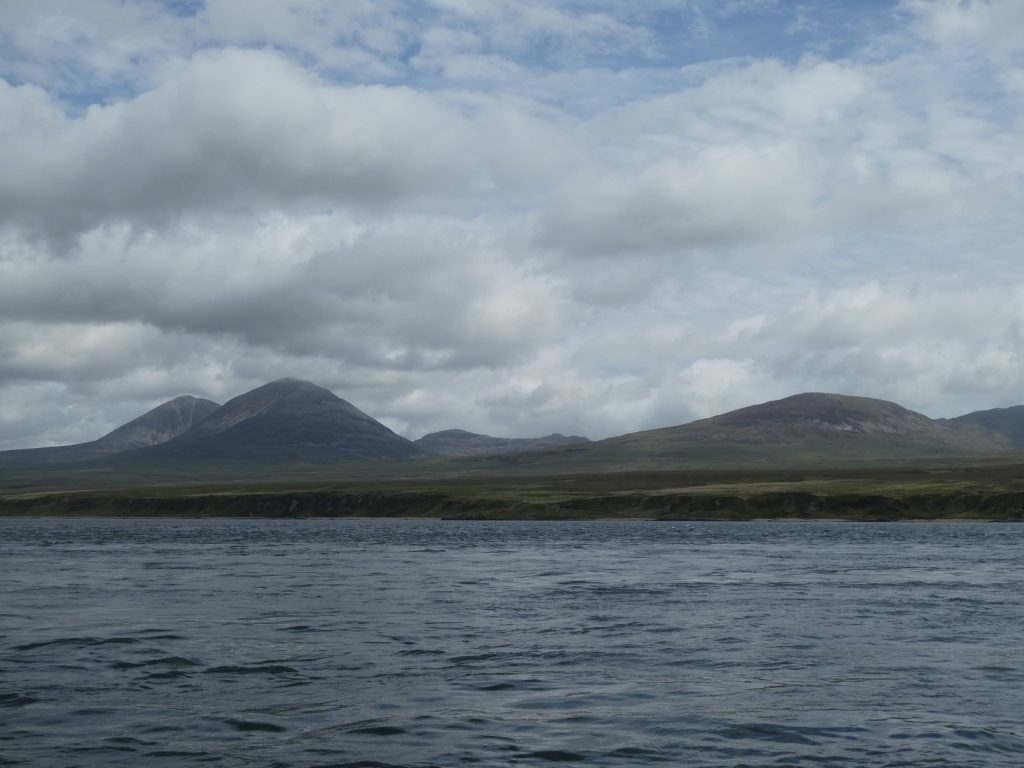
Jura isn’t an island packed with bikepacking routes, but that’s exactly why it works. With one main road, a handful of excellent gravel detours, huge stretches of empty coastline and a population dwarfed by its red deer, the appeal is less about ticking off trails and more about the feeling of being somewhere genuinely remote. Add golden beaches, clear water, wild camping and the Paps dominating the skyline, and Jura becomes one of those places where slowing down matters more than covering distance.
About this guide
This guide is built from first-hand experience. Most of it comes directly from notes I made while riding and camping around Jura — often late at night in the tent, after experiencing the routes, weather and logistics described below.
Where information didn’t come directly from me, it came from other bikepackers I met on the island or from later first-hand contributions. This isn’t generic destination information copied together from around the web. Where practical details needed updating — such as ferry information, opening times or current services — I’ve checked them against current operator or business information.
Details such as prices, ferry timetables and opening times can change. Everything was accurate to the best of my knowledge when published, but if you spot a mistake, have an update or think something is missing, please get in touch.
Affiliate disclosure: Some links on this page are affiliate links. If you make a booking or purchase through one of them, FTtouring may earn a small commission at no extra cost to you. I only include links where they are relevant and useful to planning the trip.
When to Go
May to September is the best window for bikepacking Jura, with longer days, milder temperatures and the island’s ferries, campsite and seasonal businesses generally operating at their most useful. I rode Jura in May 2026 and had a good mix of sunshine and showers, with manageable wind and generally comfortable riding conditions.
Late spring is probably the sweet spot. The island is beginning to green up, daylight is long and rainfall is typically lower than later in the year. Midges can already be a problem on still evenings, though, and they became particularly bad whenever the wind dropped during my trip.
Summer brings the warmest conditions, but also the highest midge pressure and more visitors. Early autumn can still work well, although wetter and windier Atlantic weather becomes more common as the season progresses. Winter is possible, but shorter days, stronger winds and reduced seasonal services make it far less appealing for a bikepacking trip.
Bike & Packing Recommendations
Jura suits a wide range of bikes, but the best setup depends on how much of the island’s gravel and estate-track riding you want to include. I rode it on a Kona Unit X with 29 × 2.6in tyres, which was excellent once I left the tarmac but noticeably draggy on the long road sections.
If I were riding Jura again, I’d probably aim for something around 2.0–2.4in. That gives enough volume and grip for the rougher gravel while keeping the bike noticeably quicker on the A846. A gravel bike, rigid mountain bike or capable touring bike would all work well, provided you’re comfortable with rough tracks and occasional boggy ground.
The island doesn’t demand an expedition setup, but a little self-sufficiency goes a long way. Away from Craighouse, services thin out quickly, water becomes less obvious and track conditions can vary significantly. Carry basic tools, enough food and water for the day, waterproofs, midge protection, a tick remover and a water filter if you plan to spend time away from the main road.
Recommended for Jura:
- Waterproofs
- Midge repellent or head net
- Tick remover
- Basic tool and puncture-repair kit
- Water filter
- Power bank
- Warm layers
- Offline maps / GPX navigation
Getting To/From Jura
Jura is straightforward to reach with a bike, but your route onto the island depends on whether you’re coming via Islay or directly from the mainland.
The short Port Askaig–Feolin ferry is the main year-round connection and the route I used, while a seasonal passenger ferry links Tayvallich with Craighouse during the warmer months.
From Islay:
The main connection to Jura is the short ferry from Port Askaig on Islay to Feolin. The crossing takes only a few minutes and is particularly convenient if you’re combining Jura with Islay as part of a longer island-hopping trip. If you’re travelling to Jura from mainland Scotland via Islay, you can compare and book the mainland–Islay ferry through Direct Ferries before connecting with the short Port Askaig–Feolin crossing.
The service is operated by Argyll and Bute Council and runs as a turn-up-and-go ferry for most sailings. As of 2026, an adult passenger pays £2.55 each way or £5.10 return, with bicycles travelling for free. Tickets can be bought online, through the Jura Ferry app or from the crew on board. If buying on board, exact cash is preferred and card payment is accepted.
There are frequent crossings throughout the day from Monday to Saturday, with a reduced Sunday service. Most daytime sailings do not need to be booked, although some early and late services are bookable in advance. The ferry has a quick turnaround at Feolin, so it is worth being at the pier a little early.
The Feolin side is very basic, with little more than an information board and bin, so don’t arrive expecting food, water or other services. Craighouse is the first proper place to resupply once you’re on the island.
Official booking/tickets: Argyll & Bute Council Jura Ferry ticket site
Timetable enquiries: 01496 840681
Ticket enquiries: 01631 569167 or 01546 604578
Email: Ferrytickets@argyll-bute.gov.uk

From Mainland Scotland
The quickest way to reach Jura directly from the mainland is the seasonal Jura Passenger Ferry from Tayvallich to Craighouse. Unlike the Port Askaig–Feolin service, this is a passenger ferry rather than a vehicle ferry, but bicycles are welcome.
The crossing takes around 50 minutes and lands directly in Craighouse, putting you beside the community shop and within easy reach of the island’s main services. For a bikepacker arriving without a car, it is probably the simplest way to reach Jura from mainland Scotland.
In 2026, the service operates from April into October on Mondays, Wednesdays, Fridays and Sundays. There are normally two sailings each way on Monday, Wednesday and Friday, with a reduced Sunday service. Advance booking is recommended, and passengers should arrive at least ten minutes before departure.
As of May 2026, fares are priced at £27.50 each way for an adult, with bicycles charged at £2.50. There is a standard 20kg luggage allowance per passenger, so if you’re travelling with a heavily loaded touring bike it is worth contacting the operator beforehand.
Operator: Nicol Mackinnon / Islay Sea Safaris.
Website: Jura Passenger Ferry
Phone: 07768 450000
Back to the mainland
Leaving Jura is straightforward, but your best option depends on where you’re heading next.
If you’re continuing through Islay, simply take the Feolin–Port Askaig ferry and continue riding from there.
If you want to return directly to mainland Scotland, the seasonal Jura Passenger Ferry from Craighouse to Tayvallich is the quicker option when it is running. If you’re heading back towards the mainland via the Kintyre Peninsula, then another option is to take the Feolin–Port Askaig ferry to Islay and then connect at the same port to Kennacraig. That second leg can be compared and booked through Direct Ferries here.
If you’re travelling with a loaded bike, check the latest sailing times before committing to your final day’s route. Services are frequent enough from Feolin, but the Tayvallich ferry operates on a much more limited seasonal timetable.
Weather
Jura has a mild but exposed west-coast climate, and wind and rain are more likely to shape a bikepacking trip than extreme temperatures. I rode the island in May 2026 and had a good mix of sunshine and showers, with manageable winds and generally comfortable riding conditions.
That said, conditions can change quickly. The exposed west coast, open stretches of the A846 and higher ground around the Paps can feel much harsher when the wind gets up, while inland tracks can stay wet and boggy long after the rain has stopped.
Seasonal Breakdown
Spring (March → May)
Spring is one of the best times to ride Jura. Days are getting longer, rainfall is generally lower than later in the year and May is often one of the more settled months. Midges can already be a problem on still evenings, but they are usually less persistent than in high summer.
Typical daytime temperatures:
March: 3–9°C
April: 5–11°C
May: 7–14°C
Summer (June → August)
Summer brings the warmest weather and longest days, which makes it an excellent time for longer rides and coastal camping. The trade-off is midges, which can be extremely bad when the wind drops, particularly around sheltered woodland and inland camping spots.
Typical daytime temperatures:
June: 10-16°C
July: 11–18°C
August: 11–18°C
Autumn (September → November)
Early autumn can still be very good for bikepacking, but conditions become more unsettled as the season progresses. Rainfall increases, winds strengthen and daylight shortens quickly. September can still be a good compromise, while October and November are much less predictable.
Typical daytime temperatures:
September: 9–15°C
October: 6–12°C
November: 4–9°C
Winter (December → February)
Winter is the least practical season for bikepacking Jura. Short days, stronger Atlantic winds, wetter ground and reduced seasonal services make the island significantly more demanding. It is still possible to ride, but for most visitors there are much better times of year.
Typical daytime temperatures:
December: 3-8°C
January: 3-8°C
February: 3-8°C
Camping & Accommodation
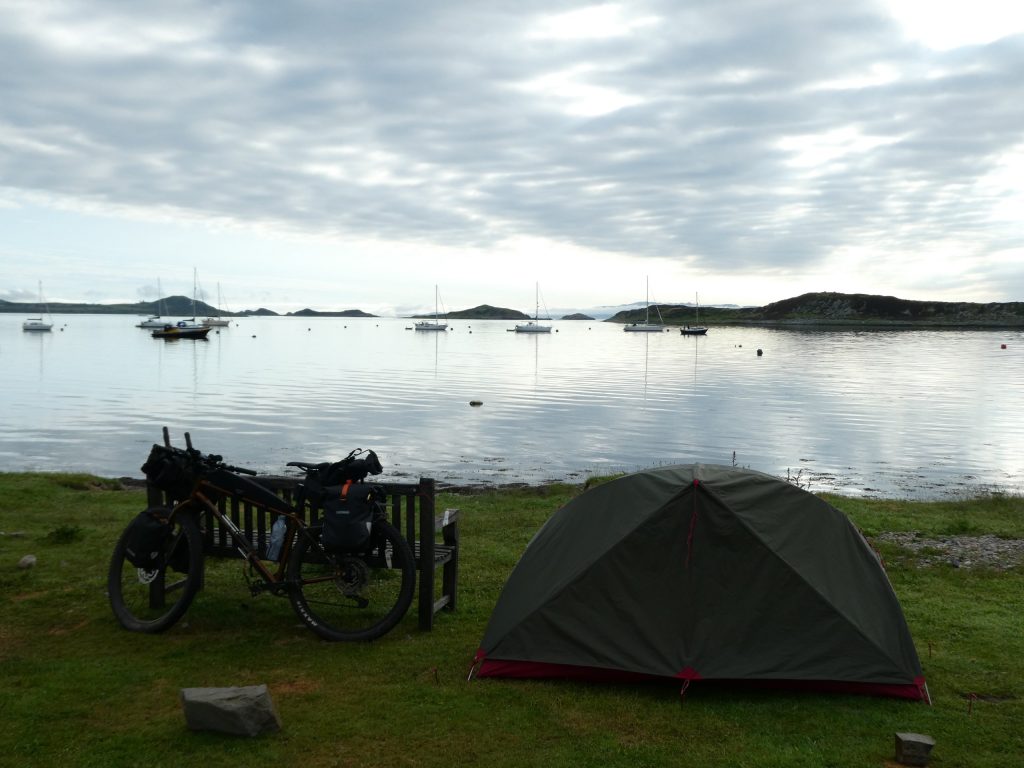
Jura has a surprisingly broad range of accommodation for such a sparsely populated island, but for bikepackers the two most obvious options are camping at Craighouse or wild camping.
There is also a hotel, one B&B and a selection of self-catering properties spread around the island, although choices become much thinner once you leave Craighouse.
Hotels/B&Bs/Self-Catering
Rather than list every holiday cottage on the island, these are the options I’d consider most useful for someone travelling by bike. For the full current accommodation list, the official Isle of Jura website maintains an updated 2026 accommodation map and directory.
Jura Hotel
Address: Craighouse, Isle of Jura, PA60 7XU
Website: Jura Hotel
Email: enquiries@jurahotel.com
The island’s main hotel and probably the most convenient non-camping option for a bikepacker. It sits in Craighouse close to the community shop, ferry landing and other services, and also has Jura’s only pub.
Corran House B&B
Address: Corran Sands, Isle of Jura
Phone: 01496 820374
Email: fionajwalton@hotmail.co.uk
Website: Official Jura accommodation listings
Jura’s only currently listed B&B, sitting directly beside Corran Sands. Its location makes it particularly useful for a cyclist who wants to stay outside Craighouse while remaining only a short ride from the island’s main services.
Bothan Jura Retreat
Address: Knockrome, around 5km north of Craighouse
Website: Bothan Jura Retreat
Email: hello@bothanjuraretreat.co.uk
Phone: +44 (0)7300 493078
This is a more expensive self-catering option rather than a conventional overnight stop, but it may suit riders wanting a couple of nights off the bike. The retreat includes Mrs Leonard’s Cottage and several cabins/huts, with a two-night minimum on the main accommodation.
Lorne Cottage
Address: Craighouse
Website: Lorne Cottage
Email: bookings@juralornecottage.com
Phone: +44 (0)7387 311981
A self-catering cottage sleeping four to six, right beside the shore in Craighouse. It is one of the more convenient cottages for cyclists because the village shop, food and other services are nearby.

Campsites
Jura has one main formal campsite, conveniently located at Craighouse and part of the Jura Hotel. For bikepackers, it is particularly useful because it puts you within easy reach of the community shop, food, water and the passenger ferry, while still giving you somewhere straightforward to stop without needing to search for a wild-camping pitch.
(All information correct as of May 2026)
Craighouse
Jura Hotel Campsite
The campsite is part of the Jura Hotel at Craighouse and is the island’s main formal camping option. Camping runs 1 April–30 September. When I stayed there in May 2026, a basic pitch was £10 per night, showers £1 per four minutes; washing machine £4 and dryer £2.50.
Head into the hotel reception to book a pitch at the front desk. Payment is by cash or card. A £5 refundable cash deposit is required for an access key into the toilets and showers. Campers are also welcome to use the hotel bar and restaurant as part of their stay.
The site is simple rather than luxurious, but it gives bikepackers exactly what they need: a legitimate place to pitch, access to water, toilets and washing facilities, and a very convenient location close to Craighouse’s main services.
Contact Details:
Address:
Jura Hotel Campsite
Craighouse, Isle of Jura, Argyll, Scotland
Website:
Phone:
01496 820243.
Email:
Wild Camping
Wild camping is one of Jura’s biggest strengths as a bikepacking destination. The island feels remote almost everywhere, traffic is light and there are plenty of coastal areas where responsible camping is possible under the Scottish Outdoor Access Code.
The main difficulty is finding dry, level ground. Inland areas can be extremely boggy for much of the year, and even places that look suitable on a map can turn out to be wet or uneven once you arrive. In my experience, the coast generally offered the best options.
Corran Sands was one of the easiest and most obvious places I found. There is a large grassy area beside the beach that is used regularly by campers, with golden sand, a quiet bay and plenty of space when conditions are good.
Around Lagg, following the pier road out towards the peninsula also revealed several grassy coastal spots with views towards mainland Scotland. These felt quieter and more tucked away than Corran Sands.
There are also a couple of pine-forest areas that can work if you need shelter, although the ground is often uneven and finding a genuinely flat pitch can take some searching. The bigger problem in woodland is midges. On still evenings they can be brutal, so whenever possible I’d favour a breezier coastal pitch.
As elsewhere in Scotland, keep camps small and discreet, avoid homes and working land, leave no trace and move on if a spot is clearly unsuitable.

Food & Resupply
Craighouse is the main place to resupply on Jura and, for a bikepacker, it does most of the heavy lifting. The community shop is well stocked for the size of the island and I never felt that food supplies were a serious problem during my trip.
The shop carries the usual basics you’d expect for a short tour, along with drinks, snacks and enough fresh and packaged food to restock for a couple of days. Prices are a little higher than on the mainland, but still reasonable for an island shop.
Away from Craighouse, options are non-existent, so if you’re heading north or planning to spend time on the gravel routes it makes sense to carry what you need.
Craighouse
Jura Community Shop
The shop is the island’s main general store and the key resupply point for bikepackers. The same building also operates the local Post Office, which is useful for cash withdrawals and normal postal services.
Current summer 2026 opening hours:
- Monday, Tuesday, Wednesday, Friday, Saturday: 09:00–17:00
- Sunday: 12:00–16:00
- Thursday: 09:00–around 11:00/12:00, then 14:30–17:00, with a closure in the middle of the day for delivery and restocking
Post Office:
- Monday–Saturday: 09:00–15:00
- Closed during the Thursday restocking closure
Eating Out
Eating out on Jura is fairly limited, but Craighouse has enough choice to give bikepackers a proper meal, coffee or takeaway without needing to rely entirely on camp food. Opening days can change seasonally, so it’s worth checking current times before planning around a particular place.
The Antlers Bakehouse & Bar — Craighouse, opposite the community shop.
Current 2026 hours: Tuesday–Thursday 10:30–16:00; Friday 10:30–16:00 and 17:30–20:30; Saturday 11:30–16:00. Seasonal, so check before relying on it.
Contact: theantlersjura@gmail.com.
Coffee, cakes, baked goods, sandwiches, soups, salads, pies, drinks and some evening food.
Jura Hotel & Pub — Craighouse.
Contact: enquiries@jurahotel.com.
The island’s main sit-down meal and pub option, with food such as fish and chips, burgers, pies, steak and daily specials.
Jura Seafood — collection from Craighouse Big Pier or the village.
Contact: Richard on 07826 527 901.
Lobster, crab and langoustine ordered directly. No fixed shop hours; order in advance and arrange collection.
Jean’s Fish Van — Craighouse, outside the distillery.
Contact: 07715 036 041.
Visiting fish van selling fresh and smoked fish, shellfish and related produce. Usually Thursdays at around 13:45. Orders requested by Tuesday at 12:00.
Wild Jura Venison — mainly available through Jura Community Shop, with occasional van service.
Useful for self-catering and camp cooking rather than eating out.
Water
Water needs a little more planning on Jura than food. Craighouse is the easiest place to fill up, but reliable public water becomes much less obvious once you head away from the village and onto the more remote tracks.
There is a tap at the community hall beside the Jura Community Shop, but permission should be asked before using. There is also water available at the campsite at the Jura Hotel. I was also told there is a tap in the toilets near the pier in Craighouse, although I never found it. Unlike a lot of the islands in the area, there are no public refill stations on Jura.
Away from Craighouse, I wouldn’t rely on finding obvious public taps. Asking at houses or farms is always an option, but if you’re heading north or onto the longer gravel sections it makes sense to leave with enough water for the day.
Natural water is available in places, but because Jura has such a large deer population and livestock is present around parts of the island, I would always filter or treat it before drinking.
For me, that makes a water filter one of the more useful things to carry on Jura, especially if you’re wild camping or spending time away from the main road.
Bikepacking Routes on Jura
Jura doesn’t have a huge network of bikepacking routes, but the riding it does have is excellent. The main A846 forms the backbone of the island, with a handful of gravel and estate-road detours adding much more variety than the map initially suggests.
I rode all of the main routes below during my trip in May 2026. Conditions vary considerably: some sections are smooth gravel, others are rougher estate tracks, and inland ground can become very boggy away from established surfaces. The main road itself is narrow but generally in good condition, with extremely light traffic.

For most riders, the best way to experience Jura is to use the A846 as the main spine of the trip, then add the gravel extensions and northern detours that suit the time available.
The Long Road / A846
The A846 is Jura’s main road and the obvious starting point for any bikepacking trip on the island. It runs north from Feolin through Craighouse, Lagg, Tarbert and Ardlussa before eventually giving way to rougher tracks towards the northern end.
It is narrow, with passing places and very little traffic, and is often described as one of Britain’s loneliest A-roads. The riding is mostly straightforward tarmac, but the sense of remoteness grows quickly once you leave Craighouse behind. There are still enough hills, including the occasional steep climb, to keep things interesting.
Inver Estate Gravel Route
Close to Feolin, this estate-track route gives you an immediate taste of Jura away from the main road. It works as a loop, bringing you back to the port, and combines rougher gravel, estate roads and remote coastal riding, with excellent views back across the island and towards the Paps.
This is one of the better off-road options on Jura and works particularly well if you want to add some gravel before or after using the ferry at Feolin.
Lowlandman’s Bay Gravel Detour
This is a short out-and-back gravel detour from the main road that leads towards Lowlandman’s Bay, a beautiful spot on the island that’s well worth the detour. The route starts at Corran Sands and includes grassy tracks, small bridges and farm roads before dropping towards the coast.
There is a walking link at the far end that appears to create a loop, but in practice it involves very high deer-fence stiles and is not worth attempting with a loaded bike. The better option is simply to enjoy the ride in and return the same way.
Tarbert Bay / Loch Tarbert
The track towards Tarbert Bay and Loch Tarbert adds another worthwhile gravel section to the main road route. The surface becomes rougher in places and conditions can vary significantly depending on recent weather.
It is a good example of what makes Jura interesting by bike: a relatively small detour can take you very quickly from quiet tarmac into much wilder terrain.
Northern Jura / Barnhill / Corryvreckan
Beyond the end of the public road, the route continues north on rougher tracks towards Barnhill, the remote house where George Orwell wrote much of Nineteen Eighty-Four.
You can continue riding beyond the road for a reasonable distance, but if you want to reach the Corryvreckan viewpoint at the far north of the island, the final section is best tackled on foot. The ground becomes rougher and boggier, with some steep step-downs, and this is not a route to treat as fully rideable from start to finish.
The reward is one of the most remote-feeling parts of Jura and a chance to look out towards the famous Corryvreckan Whirlpool between Jura and Scarba.
Best Of Jura Route Guide
The Best of Jura Route Guide brings together the island’s main bikepacking routes, linking quiet tarmac, estate tracks and remote gravel into a collection of rides that show off far more of Jura than the A846 alone.
It includes the Long Road, the Inver Estate loop, Lowlandman’s Bay, Tarbert Bay and the northern extension towards Barnhill and Corryvreckan, with route notes based on my own rides around the island.
The Best of Jura Route Guide includes GPX files and everything you need to experience Jura’s best routes

Cycle Shops & Repairs
Jura doesn’t have a full-sized bike shop, so it’s worth arriving with enough tools and spares to deal with the usual problems yourself. A pump, puncture-repair kit or spare tube, tyre levers, multitool and a couple of spare chain links should cover most roadside issues.
The most useful local contact is Jura Cycles in Craighouse. It operates bike and e-bike hire and is the logical first place to ask if you run into a minor mechanical problem.
For anything more serious, you may need to look towards Islay or the mainland, so self-sufficiency matters more here than it does on a larger island.
Cycle Shops & Repair Services
Public Bike Repair Stations
I couldn’t find any dedicated public bike repair stations on Jura, so don’t arrive expecting fixed tool stands or public pumps.
With no full bike workshop on the island, it makes sense to carry the basics yourself and treat Jura Cycles in Craighouse as the first place to ask if you need help with a minor issue.
Cycling Clubs on Jura
There doesn’t appear to be a dedicated cycling club based on Jura itself, which isn’t too surprising given the island’s small population and limited road network. Cycling here is much more about independent exploration than organised club riding.
Bikepacking Highlights on Jura
Jura’s highlights aren’t really about ticking off a long list of attractions. What makes the island memorable is the combination of quiet roads, remote gravel tracks, huge views and the feeling that you’re often a long way from anywhere.

1. The Paps of Jura
The three Paps dominate the southern half of the island and are the landscape feature you keep coming back to while riding. Even if you don’t hike them, they shape the whole feel of Jura and make a constant backdrop to the roads and tracks and look much bigger and atmospheric when the weather turns.
2. Corran Sands
One of the best beaches on the island and one of my favourite places to stop. When the weather is right, the golden sand and clear water are hard to beat, and it’s also a very good area for wild camping.
3. Northern Jura, Barnhill & Corryvreckan
The further north you go, the more remote Jura feels. Barnhill, where George Orwell wrote much of Nineteen Eighty-Four, is a memorable destination in its own right, while continuing north on foot towards the Corryvreckan viewpoint adds one of the wildest finishes to a Jura ride.
4. Wild Camping with Red Deer
Jura’s deer are everywhere. On one night, they came close enough to my tent that the sound of them tearing at the grass woke me. Combined with the quiet coastline and almost complete lack of light or traffic, it’s one of the things that makes camping here feel genuinely wild.
5. Jura Distillery
Right in the heart of Craighouse, Jura Distillery is one of the island’s best-known landmarks and an easy stop to work into a ride. Even if you’re not planning a tour, it’s worth seeing simply because of how closely the distillery is tied to the identity of the island and the village itself.
Bikepacking Jura on a Budget
Jura can be a relatively cheap island to explore by bike, particularly if you’re happy to wild camp and use the community shop rather than eating out for every meal.
When I visited in May 2026, the campsite at Craighouse was £10 per night. Showers, laundry and some other facilities used a separate token system, so the final cost depends on how much you use. Wild camping obviously brings accommodation costs down further.
The Jura Community Shop is reasonably priced for an island shop. You’ll still pay a little more than on the mainland, but I never felt the difference was large enough to justify carrying huge amounts of food onto the island.
The main unavoidable cost is the ferry. The Port Askaig–Feolin crossing is very cheap, while the direct Tayvallich–Craighouse passenger ferry costs considerably more. If you’re already travelling through Islay, Jura can therefore be added to a longer trip without adding much to the overall budget.
If you wild camp, cook most of your own food and use the Port Askaig ferry, Jura can be explored very cheaply. Spend a little locally when you can, though. The community shop, cafés, hotel and other small businesses are important to an island with such a small population.
Safety
Jura feels exceptionally safe to explore by bike, and during my trip the main risks came from the environment rather than from people or traffic.
The A846 is narrow and has relatively few passing places, but traffic is extremely light and drivers generally have plenty of room to slow down and pass carefully. Road surfaces are usually good, although rougher patches and potholes do appear.
Away from the road, the main issues are remoteness, boggy ground and rapidly changing weather. Some estate tracks are straightforward gravel, while others can become rough, wet or slow-going depending on recent rain. Inland ground in particular can stay boggy for long periods.
Mobile signal was generally good during my trip, but it became less reliable around the Paps and towards the northern end of the island. If you’re heading into those areas, download your maps and GPX files in advance rather than relying on a live connection.
For most riders, basic self-sufficiency is enough: carry tools, waterproofs, food, water, offline navigation and something for midge and tick protection.
5 Things I Wish I’d Known Before Bikepacking Jura
- The midges can be brutal
- The beaches are incredible when the weather behaves
- The people are extremely friendly
- Wild camping can be harder than it looks
- Jura feels much more remote than the map suggests
Additional Notes – Midges, Wildlife & Ticks
Midges
Midges can be a serious problem on Jura, and during my visit they were among the worst I’ve experienced anywhere in Scotland when the wind dropped.
They are most troublesome on warm, still evenings and in sheltered areas such as woodland, long grass and inland camping spots. In the right conditions they can turn an otherwise perfect pitch into somewhere you really don’t want to sit outside for long.
The simplest defence is often choosing your campsite carefully. Coastal pitches usually benefit from more breeze, and even a light wind can make an enormous difference. It’s one of the reasons I’d generally favour camping near the coast rather than among sheltered trees during the main midge season.
Carry a decent midge repellent and a head net if you’re visiting from late spring through summer. Neither weighs much, and on a still Jura evening you’ll be very glad you packed them. If you forget to pack them, the community shop and Jura hotel usually have them in stock.
Midges shouldn’t put you off visiting, but they are something worth taking more seriously here than on some of Scotland’s more exposed islands.
Wildlife
Red deer are the wildlife you’re most likely to notice on Jura, and they are difficult to miss. The island’s deer population far outnumbers its human population, and I saw them regularly along the roads, around camping areas and on the open hillsides.
Seals are also commonly seen around the coast. Otters are present on Jura too and the area around the ferry port and Corran Sands are apparently great places to spot them.
Birdlife is also noticeable throughout the island, particularly around the coast and quieter inland areas.
As always, the best way to see wildlife is simply to slow down. Jura’s quiet roads and low traffic make that easy, and travelling by bike gives you plenty of chances to notice what’s around you.

Ticks
Ticks are a genuine issue on Jura, particularly because of the island’s large red deer population and the amount of long grass, heather, bracken and rough ground you’re likely to move through while camping or exploring away from the road. They’re most active from spring through to autumn, although mild weather can extend the season.
Check yourself regularly, especially after pushing through vegetation or sitting around in long grass. Pay particular attention to warm, hidden areas such as behind the knees, around the waistband, groin, armpits, neck and sock line.
Carry a proper tick-removal tool. If you find a tick attached, remove it as soon as possible following the tool’s instructions, or use fine-tipped tweezers to grip it as close to the skin as possible and pull steadily upwards without crushing it. Avoid Vaseline, oils or other home remedies.
After removal, clean the area and keep an eye on it. Lyme disease can cause an expanding circular or oval rash and flu-like symptoms, although a rash does not always appear, so seek medical advice if you become unwell after a tick bite.
Spotted something wrong or have updated information? Get in touch here


